Wednesday, 1 March 2017
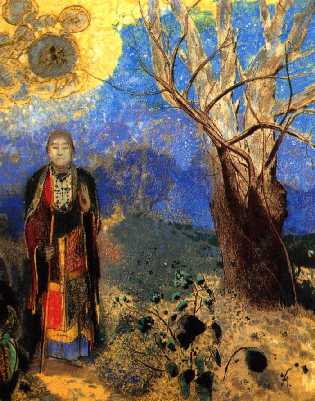
Odilon Redon 1840–1916
Odilon Redon was a French symbolist painter, printmaker, draughtsman and pastellist. Redon had a keen interest in Hindu and Buddhist religion and culture. The figure of the Buddha increasingly showed in his work. Influences of Japonism blended into his art, such as the painting The Death of the Buddha around 1899, The Buddha in 1906, Jacob and the Angel in 1905, and Vase with Japanese warrior in 1905, amongst many others.

Osho Zen Tarot: The Lovers
What we call love is really a whole spectrum of relating, reaching from the earth to the sky. At the most earthy level, love is sexual attraction. Many of us remain stuck there, because our conditioning has burdened our sexuality with all kinds of expectations and repressions. Actually the biggest "problem" with sexual love is that it never lasts. Only if we accept this fact can we then really celebrate it for what it is--welcome its happening, and say good-bye with gratitude when it's not.
Then as we mature, we can begin to experience the love that exists beyond sexuality and honors the unique individuality of the other. We begin to understand that our partner often functions as a mirror, reflecting unseen aspects of our deeper self and supporting us to become whole. This love is based in freedom, not expectation or need. Its wings take us higher and higher towards the universal love that experiences all as one.
These three things are to be taken note of: the lowest love is sex--it is physical--and the highest refinement of love is compassion. Sex is below love, compassion is above love; love is exactly in the middle.
Very few people know what love is. Ninety-nine percent of people, unfortunately, think sexuality is love--it is not. Sexuality is very animal; it certainly has the potential of growing into love, but it is not actual love, only a potential....
If you become aware and alert, meditative, then sex can be transformed into love. And if your meditativeness becomes total, absolute, love can be transformed into compassion. Sex is the seed, love is the flower, compassion is the fragrance.
Buddha has defined compassion as 'love plus meditation'. When your love is not just a desire for the other, when your love is not only a need, when your love is a sharing, when your love is not that of a beggar but an emperor, when your love is not asking for something in return but is ready only to give--to give for the sheer joy of giving--then add meditation to it and the pure fragrance is released.
That is compassion; compassion is the highest phenomenon.
Osho Zen, Zest, Zip, Zap and Zing, Chapter 3
Outer Limits vs The Terminator
Night comes too soon on the battlefield. For some men it comes permanently; their eyes never open to the light of day. But for this man, fighting this war, there is never total darkness. The spidery beams of light in the sky are the descendants of the modern laser beam — heat rays that sear through tungsten steel and flesh as though they were cheesecloth. And this soldier must go against those weapons. His name is Qarlo, and he is a footsoldier, the ultimate infantryman. Trained from birth by the State, he has never known love, or closeness, or warmth. He is geared for only one purpose: to kill the Enemy. And the Enemy waits for him… From the darkest of all pits, the soul of Man, come the darkest questions: Did the soldier finally come to care for those he protected? Or was it just his instinct to kill? Questions from the dark pit. But no answers. For answers lie in the future. Is it a future in which men are machines, born to kill, or is there time for us? Time. All the time in the world… but is that enough?
Science fiction author Harlan Ellison brought suit against The Terminator production company Hemdale and distributor Orion Pictures for plagiarism of this episode. According to the Los Angeles Times, the parties settled the lawsuit for an undisclosed amount, and an acknowledgement of Ellison's works in the credits of Terminator. James Cameron emphatically denied Ellison's allegations and was opposed to the settlement, stating "For legal reasons I'm not suppose [sic] to comment on that (the addition of acknowledgement credits) but it was a real bum deal, I had nothing to do with it and I disagree with it."
Tuesday, 28 February 2017
Richie Havens: Freedom (Woodstock, 1969)
Haven's song “Freedom” became the anthem for a generation when he ran out of material after demand for numerous encores. Richie played through his entire set and had to keep playing due to the next act being late because of the insane traffic at the festival. He began splicing the blues song “Motherless Child” with “Freedom”, and when the particular cut of the song was put on the film Woodstock, it instantly became an international hit. A pertinent song for these doleful times.
The ambient serenity coupled with the accidental beauty stays with those who have heard it and the song remains a patchwork folk classic. (From: Woodstock Story)
Santana: Soul Sacrifice (Woodstock, 1969)
Santana used to have a massive percussion section at that time and drummer Michael Shrieve added his personal note, especially during the drum solo of Soul Sacrifice. In several interviews, Santana recalled experiencing the effects of psychedelics during the performance, claiming he was tripping on LSD throughout most of the performance and was hallucinating that his guitar was a snake. Nevertheless, he got it together for the finale and performed flawlessly. "By the time we got to 'Soul Sacrifice', I had come back from a pretty intense journey. Ultimately, I felt we had plugged in to a whole lot of hearts at Woodstock"
The Macrobiotic Way of Life
My final contribution from the leaves of the strangely magnetic Spiritual Community Guide. During my student years, this whacky eating system held a strange power over me, especially with its kooky connections with Zen, spirituality, martial arts, asceticism, and general esoteric philosophical balderdash. Ho hum. Everything is the differentiated manifestation of one infinity as they say. After a short while of eating on the 10th Regimen of the macrobiotic diet, I became supremely serene. You could say, harmonised. The kind of joyful productive mood where if one of your friends asks if you'd like to help someone move house from Liverpool to London, you say "of course" out of great concern for every soul that inhabits the planet. I dutifully boiled up some chickpeas and brown rice, and took them along with me in a huge bowl.
Things got off to a bad start with the move; the woman who was moving had done exactly f@ck all to pack when we got there at 9pm (moonlit flit), so we were stuck waiting until 1am. But it was alright because I had my bowl of macrobiotics. Everything Changes. When we eventually got packed up and drove down to London, we got to the outskirts of somewhere Londony when the Luton van broke down. Maybe it was Luton, although Nothing is Identical. But it was alright because as we waited 3 hours for the roadside recovery to arrive and tow us to a different Londony place, I had my bowl of macrobiotics. When we arrived in the new flat, we had had no sleep but offloaded everything. It turned out the woman hadn't bothered to empty her freezer so it was dripping with defrosted junk food. This was offered to us as a derisory breakfast. But it was alright, I was able to refuse because I had my dwindling bowl of macrobiotics. The Luton van was left in London, and there was a saga involving procurement of a hire car. We only set off returing from London at about 9pm the next day, still with no sleep. What has a Front has a Back. It turns out the Bigger the Front, the Bigger the Back. I had run out of macrobiotics.
The journey back was treacherous as I remember it; torrential dark rain and squeezing through narrow gaps where trucks had strained neck and neck, offering only a narrow eyed hope of passing them alive in the fast lane. Without macrobiotics, the prospect of death was strangely polar, oscillating between Love for Everything, and concern for my ass as it waved goodbye to my descending blood sugar below. All antagonisms are complementary. What begins, ends. I never went back to Macrobiotics.
Labels:
BodyMind,
Books,
Health,
North Utsire,
Quotes,
Recipes,
Spirituality,
World,
Writing,
Yoga
Goblin Market
Goblin Market is an 1862 narrative poem by Christina Rossetti. In a letter to her publisher, Rossetti claimed that the poem, which is interpreted frequently as having features of remarkably sexual imagery, was not meant for children. The most climactic moments of the poem, as well as the most notorious for their possible sexual innuendo, all involve the fruit. The fruit is engendered in lush terms and in vast lists.
The introductory stanza of the poem, the girls’ first salacious glimpse of the goblins’ proffered goods, lists no fewer than twenty-nine different “orchard fruits” being offered by the goblins. Laura sucks the globes of fruits “until her lips were sore,” corrupted by those “peaches with a velvet nap” and “Pellucid grapes without one seed.” The rape scene, the scene of Lizzie’s heroic self-sacrifice, shows the goblins attempting to force-feed her the fruit until it “syruped all her face,/And lodged in dimples of her chin.” Laura’s final salvation is accomplished when she kisses from her sister those “juices/Squeezed from goblin fruits,” the “Goblin pulp and goblin dew.” The fruit is vividly spotlighted because fruit is itself an apt symbol for the transition from green to ripe, youth to maturity. Fruit exactly mimics the process that Lizzie and Laura undergo in the story.
Goblin Market has been variously illustrated, by our old friend Arthur Rackham, and in a 1973 issue of Playboy by Kinuko Craft: "A Ribald Classic". There is also a sapphic comic book version of Goblin Market published in the 1980's, and illustrated by John Bolton. Below I have mixed up several illustrations from Goblin Market, but it doesn't take much to differentiate them to be honest.
Ten Bulls
Ten Bulls or Ten Ox Herding Pictures is a series of short poems and accompanying pictures used in the Zen tradition to illustrate the stages of a practitioner's progression towards the purification of the mind and enlightenment, as well as his or her subsequent return into the world while acting out of wisdom. The well-known ten ox-herding pictures emerged in China in the 12th century. The calf, bull or ox is one of the earliest similes for meditation practice. In the West, Alan Watts included a description of the Ten Bulls in The Secret of Zen. The pictures were eventually to influence the work of John Cage, particularly in his emphasis on rhythmic silence, and on images of nothingness.
1. In Search of the Bull
In the pasture of the world,
I endlessly push aside the tall
grasses in search of the Ox.
Following unnamed rivers,
lost upon the interpenetrating
paths of distant mountains,
My strength failing and my vitality exhausted,
I cannot find the Ox.
2. Discovery of the Footprints
Along the riverbank under the trees,
I discover footprints.
Even under the fragrant grass,
I see his prints.
Deep in remote mountains they are found.
These traces can no more be hidden
than one's nose, looking heavenward.
3. Perceiving the Bull
I hear the song of the nightingale.
The sun is warm, the wind is mild,
willows are green along the shore -
Here no Ox can hide!
What artist can draw that massive head,
those majestic horns?
4. Catching the Bull
I seize him with a terrific struggle.
His great will and power
are inexhaustible.
He charges to the high plateau
far above the cloud-mists,
Or in an impenetrable ravine he stands.
5. Taming the Bull
The whip and rope are necessary,
Else he might stray off down
some dusty road.
Being well-trained, he becomes
naturally gentle.
Then, unfettered, he obeys his master.
6. Riding the Bull Home
Mounting the Ox, slowly
I return homeward.
The voice of my flute intones
through the evening.
Measuring with hand-beats
the pulsating harmony,
I direct the endless rhythm.
Whoever hears this melody
will join me.
7. The Bull Transcended
Astride the Ox, I reach home.
I am serene. The Ox too can rest.
The dawn has come. In blissful repose,
Within my thatched dwelling
I have abandoned the whip and ropes
8. Both Bull and Self Transcended
Whip, rope, person, and Ox -
all merge in No Thing.
This heaven is so vast,
no message can stain it.
How may a snowflake exist
in a raging fire.
Here are the footprints of
the Ancestors.
9. Reaching the Source
Too many steps have been taken
returning to the root and the source.
Better to have been blind and deaf
from the beginning!
Dwelling in one's true abode,
unconcerned with and without -
The river flows tranquilly on
and the flowers are red.
Images of a Woman (Beatles, 1966)
Images of a Woman is the only known painting of the Beatles.
The oil and watercolour artwork was created by The Beatles in June and July
1966, while on tour in Tokyo . Tight
security measures meant they were unable to leave their suite at the Hilton
hotel for three nights, so they collaborated on a painting which became known
as Images Of A Woman.
After the concert, the four of
them continued working on the painting while listening to acetates of Revolver
and smoking some pot. A different picture from the same evening is reprinted in The Beatles Anthology book, although Images of a Woman is shown in The Artwork of the Beatles; a book I used to possess, but which I had to part with. Now, like the painting, its worth a pretty penny. I think in that book they said The Beatles dropped acid whilst making this painting.
Each Beatle painted parts of the 30"x40" paper,
working by the light of a lamp in the centre. When the painting was complete
the lamp was removed, and The Beatles signed the empty space next to their
contributions. The paper and paints were provided by Japanese promoter Tats Nagashima, who suggested that the completed painting be auctioned for
charity. It was subsequently bought by a cinema manager and local fan club
president Tetsusaburo Shimoyama.
The painting was auctioned off by the original owner’s wife
in 1989, ending up in the hands of a collector (and huge Beatles fan) named
Takao Nishino who paid the equivalent of half a million dollars for it; only
to run out of wall space three years later. After purchasing a special
humidity-controlled frame, he decided to box it up and slide it under his bed,
where it’s mostly stayed for the last 20 years. Says Nishino now, “Originally, I thought it might be best
kept as a piece of Japan ’s
cultural heritage; it has never left Japanese soil in 46 years. But the Beatles
phenomenon was and remains a global one.”
In September 2012 it was put up for sale again through Philip Weiss Auctions in
New York . The painting had a
pre-auction estimate of $80,000 to $120,000, but sold for $155,250 including
the buyer's premium.
Subscribe to:
Posts (Atom)


.jpeg)