A Journey Through the Pastoral Psyche of German Progressive Folk
Friday, 1 May 2026
Träumen in der Morgendämmerung
A Journey Through the Pastoral Psyche of German Progressive Folk
Saturday, 4 April 2026
Thursday, 22 January 2026
Masquerade Artwork (1979)
I have such fond memories of this strangely occult and pagan-themed book, which I remember leafing through with amazement whilst at Junior school. After decades mostly out of the public eye, the iconic treasure from Masquerade resurfaced on the market and now belongs to a collector once more. In November 2025, Sotheby’s offered the same golden hare at auction again. The pendant originally sold for £31,900 in 1988, but this time it fetched £82,550, well above its pre-sale estimate. It was bought by a private collector in Great Britain.
Masquerade is a beautifully illustrated puzzle book created in 1979 by the English artist Kit Williams. At first glance it looks like a whimsical fairy tale about a small hare named Jack who travels through a dreamlike world, but every page is quietly doing something else: hiding clues. Williams embedded riddles in the paintings, borders, and lettering so that careful readers could piece together a set of directions leading to a real, physical treasure.
That treasure was a small golden hare pendant, made of 18-carat gold and decorated with jewels. Williams buried it somewhere in the English countryside and announced that whoever solved the puzzle in the book could claim it. The idea captured the public imagination. Hundreds of thousands of people studied the illustrations with magnifying glasses, looking for patterns, hidden words, and visual jokes that might reveal the location. After nearly three years, the hare was found in Ampthill Park in Bedfordshire, though the circumstances of its discovery later caused controversy, since it was revealed that the finder had been tipped off rather than having fully solved the puzzle as intended.
The book itself became a cultural phenomenon. It essentially invented what is now called the “armchair treasure hunt,” a genre where readers try to solve elaborate puzzles from home using only what is hidden in a book. Even today, Masquerade is admired not just as a clever game but as a work of art, full of intricate, symbolic paintings that reward close attention.
Kit Williams, the creator of Masquerade, was born in 1946 in Kent, England. Trained as an artist, he wrote and illustrated the book entirely on his own, combining traditional painting techniques with a love of riddles, myths, and visual storytelling. After the success of Masquerade, he went on to design elaborate mechanical clocks for public buildings and continued working as a fine artist, producing detailed figurative paintings in oils. His reputation rests largely on how he merged art, story, and puzzle into a single experience, turning a picture book into one of the most famous real-world treasure hunts in history.
Thursday, 8 January 2026
Young America’s Dilemma (1901)
The cartoon “Young America’s Dilemma (Shall I be Wise and Great, or Rich and Powerful?)” is a chromolithograph by Louis Dalrymple that appeared as an illustration in Puck magazine in 1901. It was published in New York by Keppler & Schwarzmann, the firm that owned and issued Puck at the time.
Sunday, 21 December 2025
Ida Rentoul Outhwaite (1888–1960)
Ida Rentoul Outhwaite (1888–1960) was one of Australia’s most beloved illustrators, best known for her enchanting depictions of fairies, elves, and the natural world. Her work helped shape early 20th-century Australian children’s literature and remains admired for its delicate beauty and imaginative charm.
Born Ida Sherbourne Rentoul in Melbourne, she grew up in a creative and literary family. Her father, the Reverend Dr. John Laurence Rentoul, was a noted Presbyterian minister and academic, and her sister, Annie R. Rentoul, became a writer. The two sisters often collaborated; Annie writing the stories and Ida illustrating them. From a young age, Ida showed remarkable artistic talent; her first published illustration appeared when she was just 15.
Outhwaite rose to prominence during the Edwardian and interwar periods, when fairy art and children’s fantasy were enjoying great popularity. Her illustrations often featured ethereal fairy figures nestled in distinctly Australian landscapes; among gum trees, native flowers, and animals like koalas and kookaburras. This blend of European fairy imagery with Australian flora and fauna gave her work a unique identity.
Some of her most famous works include “Elves and Fairies” (1916), “The Enchanted Forest” (1921), “Fairyland” (1926), and “The Little Green Road to Fairyland” (1922). These books combined her luminous pen-and-ink drawings and watercolours with stories by her sister Annie or other collaborators. Elves and Fairies in particular was a landmark; one of the first large-format art books printed in Australia, and an expensive luxury edition at the time, now highly collectible.
In 1909, Ida married Arthur Grenbry Outhwaite, who became both her supporter and a frequent collaborator; some works were credited jointly to “Grenbry and Ida Rentoul Outhwaite.” Together they had four children, who occasionally served as models for her fairy illustrations.
Her art is characterised by fine, detailed linework and soft washes of colour, creating an otherworldly but tender atmosphere. Critics have often noted her ability to balance whimsy with a sense of quiet realism; her fairies seem to belong to the bush as naturally as any native bird. This helped root fantasy art in an Australian sensibility and made her a pioneer of what might be called Australian fairy imagery.
By the late 1930s, her style fell somewhat out of fashion as modernism took hold, and she produced fewer works after World War II. However, her illustrations remain iconic in Australian visual culture. Today, original Outhwaite books and prints are treasured collectors’ items, and her influence can still be seen in Australian fantasy illustration.
Thursday, 1 May 2025
LSD Studies on Artistic Creativity
When I was young, I remember covetously looking up on the bookshelf at my grandparent's house and, amongst their rather fine collection of Reader's Digest subscription tomes, was a book by Gordon Rattray-Taylor called the Science of Life: A Pictorial History of Biology. The first time they allowed me to look in it, I was utterly wrapped by the pictures, photos and stories within. I later became a biologist, and I sometimes think without this early influence, would I have even gone in that direction? Incidentally, my grandparents eventually gave me their copy of the book and I am pleaseed to say it is still a treasured possession. In The Science of Life is a vivid description of 1950's psychological experiments into artistic creativity, which I have summarised below.
Beginning in 1954, psychiatrist Oscar Janiger embarked on a pioneering study to understand how LSD influenced artistic creativity. Over seven years, he administered the drug to more than 100 professional artists, who collectively produced over 250 drawings and paintings under its effects. One such experiment, believed to be part of Janiger’s research, involved an unidentified artist who was given two 50-microgram doses of LSD, spaced an hour apart. The artist was then asked to sketch a series of portraits of the doctor who had administered the drug.
Over an eight-hour period, the artist created nine portraits, each capturing the shifting perceptions induced by LSD. As they worked, they described their evolving experience, offering a rare window into the psychedelic state and its impact on the creative process. Despite years of research, Janiger later reflected that no scientific consensus had been reached on the core elements of the LSD experience or the precise mechanisms by which the drug could enhance creativity. “Even 45 years after I started my studies,” he noted, “no scientific consensus has emerged clearly defining the core elements of the LSD state. Nor has research illuminated the specific mechanisms by which LSD can be used to stimulate creativity.” Still, he hoped that future studies would build upon his work, ensuring that his early explorations were just the beginning, not the end. You can see Janiger's experiment unfold below:
![]() |
| 20 Minutes After First Dose: Artist Claims to Feel Normal |
![]() |
| 85 Minutes After First Dose: I can see you clearly. I’m having a little trouble controlling this pencil. |
![]() |
| 2 hours 30 minutes after first dose: I feel as if my consciousness is situated in the part of my body that’s now active; my hand, my elbow… my tongue. |
![]() |
| 2 hours 32 minutes after first dose: I’m trying another drawing… The outline of my hand is going weird too. It’s not a very good drawing is it? |
![]() |
| 2 hours 35 minutes after first dose: I’ll do a drawing in one flourish… without stopping… one line, no break! |
![]() |
| 2 hours 45 minutes after first dose: [Agitated and changing medium to Tempera] I am… everything is… changed… they’re calling… your face… interwoven… who is… |
![]() |
| 4 hours 25 minutes after first dose: [After taking a break, changes to pen and water colour] This will be the best drawing, like the first one, only better. |
![]() |
| 5 hours 45 minutes after first dose: [Holding a crayon] I think it’s starting to wear off. This pencil is mighty hard to hold. |
![]() |
8 hours after first dose: Final drawing. The intoxication has worn off. |
References:
Rattray-Taylor, G. (1967). The Science of Life: A Pictorial History of Biology. Panther.
Tuesday, 1 April 2025
Malene Reynolds Laugesen (b.1969)
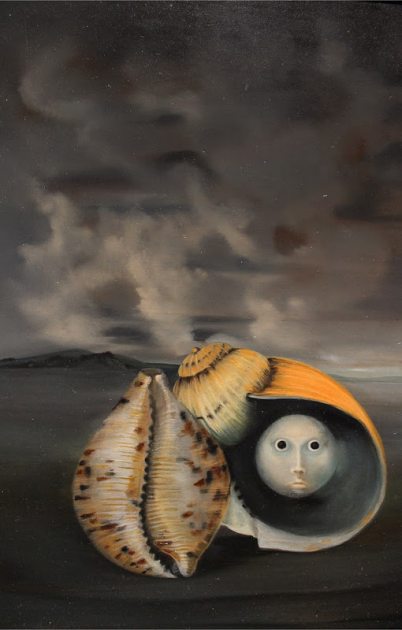
Malene Reynolds Laugesen, born in Denmark in 1969, is a Danish illustrator and painter. She studied life drawing at Glyptoteket in Copenhagen and later worked in animation before attending the Danish School of Design. In 1991 and 1992, she collaborated with Danish artist Svend Wiig Hansen. For about sixteen years, Laugesen illustrated children's books for both Danish and American markets. In 2008, she moved to Christchurch, New Zealand. Following the 2011 earthquake, she resumed painting, drawing inspiration from fairy tales and children's stories to explore themes of dreams and the subconscious.
References
Saturday, 1 March 2025
Margaret Fuller: Until My Wings Be Grown (1839)
Who can know these and, other myriad children of Chaos and old night, who can know the awe the horror and the majesty of earth, yet be content with the blue sky alone. Not I for one. I love the love lit dome above, I cannot live without mine own particular star; but my foot is on the earth and I wish to walk over it until my wings be grown. I will use my microscope as well as my telescope. And oh ye flowers, ye fruits, and, nearer kindred yet, stones with your veins so worn by fire and water, and here and there disclosing streaks of golden awe, let us know one another before we part. Tell me your secret, tell me mine. To be human is also something?"
From a letter to Caroline Sturgis, Jan 27th 1839.
Highland, Chris (Ed) (2007). Meditations of Margaret Fuller: The Inner Stream. Self Published.


-(hi-res).webp)