Showing posts with label Yoga. Show all posts

Sunday, 1 March 2026

Bhagavad Gita for Dummies

Eknath Easwaran’s commentary on the Bhagavad Gita is often praised for making the text accessible, but in doing so, it loses much of the depth and complexity that make the Gita so powerful. His approach feels less like a serious engagement with one of the world’s most profound philosophical works and more like a modern self-help manual wrapped in spiritual language. While there’s nothing inherently wrong with making ancient wisdom relevant to contemporary life, the way he does it often feels reductive, smoothing over the difficult, even uncomfortable, aspects of the text in favour of a softer, more digestible message.

One of the biggest issues is how he reshapes the Gita to fit a modern, personal-development narrative. The Bhagavad Gita is not just about mindfulness or ethical living; it’s a deeply complex dialogue that wrestles with duty, morality, devotion, and the nature of reality itself. Krishna’s teachings to Arjuna on the battlefield are filled with contradictions and nuances, often challenging simple moral conclusions. But Easwaran tends to boil these teachings down to broad life lessons about inner peace and detachment, which, while appealing, don’t fully reflect the weight of what’s actually being said. This translates into repetitive metaphors where, for the benefit of Westerners, the innermost workings of spiritual life is reduced to a car analogy. By being constantly likened to the mechanical workings of an automobile, I did wonder if I needed an oil change after reading Easwaran's commentary.

His translation also takes a lot of liberties. Instead of staying close to the original Sanskrit, he paraphrases heavily, sometimes changing the meaning in ways that simplify or distort the text. The Gita is rich with philosophical terminology; concepts like karma, jnana and bhakti yoga carry layers of meaning; but in Easwaran’s version, they sometimes feel vague, as if they’ve been sanded down to fit a general spiritual outlook rather than being explored in their full depth.

There is also the issue of how he approaches the more difficult parts of the Gita. The text, after all, is set on a battlefield, where Krishna urges Arjuna to fight. This raises profound and challenging questions about duty, violence, and moral responsibility; questions that have been debated for centuries. But Easwaran, whose own background was rooted in pacifism, tends to downplay this aspect, framing the Gita in a way that aligns with his personal philosophy rather than engaging with the raw ethical tension that makes the text so compelling. It’s understandable that he would emphasize nonviolence, but in doing so, he risks presenting a version of the Gita that feels more like a comforting guidebook than the deeply challenging spiritual text it actually is. One of the most irksome outcomes of avoiding the conflicts of life yet over-simplifying human struggle is exemplified in a section where Easwaran castigates women who must sell cigarettes for a living, saying they are forever karmically tainted as a result, owing to the health impacts of smoking. This wanton and misogynistic mis-application of spiritual truth is of course easy to come up with from the comfort of a professor's armchair. 

At the end of the day, Easwaran’s Bhagavad Gita might serve as a gentle introduction for someone new to the text, but it’s not the kind of commentary that does justice to the richness of the original. If you really want to dive into the Gita; to engage with its contradictions, its depth, and its historical context; there are far better translations and interpretations out there. Scholars like Radhakrishnan, J.A.B. van Buitenen, Mohandas Gandhi, or even A.C. Bhaktivedanta Swami Prabhupada approach the text with a seriousness that allows its full philosophical and spiritual weight to shine through. Easwaran, in contrast, offers something more like a simplified retelling; well-meaning, but ultimately too watered down with bloated clichéd lifestyle advice to capture the existential spirit of the Gita.

Image Credits:

https://www.bmcm.org/media/images/7N8A9734.2e16d0ba.fill-1016x762.jpg 

https://www.bmcm.org/media/images/7N8A9797.2e16d0ba.fill-1388x782.jpg 

https://images-cdn.ubuy.co.in/68e2063600205751d70a865a-ubuy-online-shopping.jpg 

Sunday, 1 June 2025

Saint or Swindler? Wild Wild Country (2016) vs Osho The Movie (2022)

Few figures in modern spirituality are as controversial as Osho, and few documentaries are as diametrically opposed in their portrayal of him as Wild Wild Country and Osho: The Movie. One is a gripping exposé of power, deception, and unchecked ambition, the other is a carefully curated PR campaign disguised as a film. Watching them back to back feels like stepping into two entirely different realities; one where Osho is a megalomaniacal cult leader presiding over a criminal enterprise, and another where he is a peaceful sage tragically undone by his own followers. The only real question is: which one is selling you a bigger illusion?

Wild Wild Country, the Netflix documentary that took the world by storm in 2018, is an absolute rollercoaster of madness, crime, and spectacle. It doesn’t need to embellish because the real story is stranger than fiction. A charismatic guru moves his thousands of red-robed followers to a small Oregon town, builds a utopian city, and then; because utopian cities never go as planned; everything descends into wiretapping, arson, bioterror attacks, and assassination plots. It’s a documentary that unfolds like a thriller, letting a cast of ex-Rajneeshees, Oregon locals, and law enforcement officials piece together a story that keeps getting wilder by the minute. At its centre, though largely silent for much of the runtime, is Osho himself; his presence looming over every act of devotion, every shady legal manoeuvre, every whispered conspiracy. When he does finally break his silence, it’s to throw his once-loyal secretary Ma Anand Sheela under the bus in the most passive-aggressively divine way possible.

And then there’s Osho: The Movie, a film that seems to exist primarily to rehabilitate Osho’s image, or at the very least, to make sure no one blames him for anything. Here, he is the wise master, the enlightened rebel, the man too evolved to concern himself with petty things like immigration fraud or poisoning an entire town’s salad bars. If Wild Wild Country suggests Osho might have been complicit in the darker elements of his movement, Osho: The Movie insists he was just meditating while his empire crumbled around him. The film bends over backward to absolve him, casting Sheela as the power-hungry villain who took things too far while Osho, poor innocent Osho, simply wanted to spread his message of love. Never mind that he had a fleet of Rolls-Royces or that his movement collapsed in a spectacular mess of legal battles and criminal convictions; the film would rather you focus on his radiant presence and misunderstood genius.

The biggest difference between the two films is how they treat the moral complexity of the story. Wild Wild Country doesn’t hand you a simple answer. It acknowledges that many Rajneeshees were sincere seekers who got caught up in something far bigger than themselves, that Osho was undeniably charismatic and visionary, but also that the movement was riddled with corruption, cult-like behaviour, and outright criminality. It doesn’t tell you who to believe—it simply lays out the chaos and lets you decide. Osho: The Movie, on the other hand, has no such interest in ambiguity. It isn’t here to make you think; it’s here to make you admire Osho. It cherry-picks the narrative, downplays the scandals, and frames the entire collapse of Rajneeshpuram as the tragic consequence of a few bad apples, rather than the inevitable implosion of an empire built on unchecked power.

If Wild Wild Country is an unsparing dissection of a movement that spiralled out of control, Osho: The Movie is spiritual fan fiction, written for those who still want to believe. One presents the Gita rewritten as a courtroom drama; the other, as a self-help book with all the inconvenient parts removed. The truth, as always, is probably somewhere in the middle; but only one of these films is actually interested in finding it.

My enduring takeaway from watching both documentaries is to hold Osho up as a spiritually developed man who ultimately became drug-addicted (particularly to laughing gas) and by degrees lost control of his own mass movement to opportunistic egoists. While there is no official diagnosis or historical evidence suggesting Osho was autistic, some of his traits invite speculation. His intense focus on certain philosophical ideas, unconventional communication style, disregard for social norms, and periods of isolation could align with characteristics seen in autism. However, Osho was also highly charismatic, performative, and skilled at manipulating social dynamics; traits more commonly linked to personality disorders like narcissism. While it’s unlikely Osho was autistic in a clinical sense, viewing him through a neurodivergent lens opens up intriguing possibilities about how his mind worked and what fuelled his radical approach to life and spirituality. 


Wednesday, 14 February 2024

Fischer-Lagerhaus, Neuwied

There are some stores which are just kryptonite to your wallet. I used to think I had the perfect kryptonite to avoid at all costs in the shape of B&Q, especially when they crank up that 80's style dad music; Duran Duran, Africa, Bananarama, etc. So much the more allure when I was fresh from the press with a new job, with a burning need to make DIY repairs to a new house. Well, scrub all of that. Fischer-Lagerhaus, has stores all over Germany including Neuwied near Koblenz. Their cathedral-like Aladdin's caverns purvey the most epicurean selection of ethnic trophies from around the world, from India to China, Africa to Tibet. In its splendour, taste and voluptuary elegance, it makes the likes of Dunelm Mill look like Preston Bus station in the 1970's. I have every confidence these people will bankrupt me in the most supremely ethical way, and leave me sitting in an immaculate museum piece of a house, surrounded by exotic leafy plants with furniture smelling sweetly of polished mahogany and sandalwood, as I weep into my final credit card bill with fond Sanskrit memories. 


Thursday, 21 December 2017

Winter Solstice Stroll


Taking a peaceful stroll during the long twilight of the winter solstice, along the farm tracks around the bucolic grandeur of Brinscall Hall. Apparently the Hall can be hired for cerebral writer's weekends, Yoga retreats or B'rit Milahs. OK so I was making the B'rit Milah thing up, because nobody would want you bleeding all over the Withdrawing Room rug. Might be ok in the Conservatory though, they're very accommodating. 

https://schoolofphilosophynorthwest.org/belmont-house/hiring-brinscall-hall/

Sunday, 17 September 2017

Osho Energy Darshans


The term  "Energy darshan" first appears in Osho material from Feb 1976 to denote events, where people would be invited by Osho to come close and be touched or guided to allow "their energy to move" while in specified postures. Sometimes Osho would ask another sannyasin in attendance to stand behind the recipient, hold their hands or whatever. These "shaktipat" (energy transmission) events were a regular occurrence with Osho.


In Feb of 1979, Darshans became wilder, more extravagant and on a much larger scale, coming to involve the whole ashram. The "mediums" Osho asked to assist in these energy transmissions became more numerous, and exclusively women, where before there had been occasionally a man.


With recipients of the energy transmission, those on whom Osho's energy was focused; in the past it had always been just one person at a time, with the occasional exception of two closely-related sannyasins, but soon it became several, which also entailed more mediums.


Another feature was music. It is not known when exactly musicians were added to this energy soup, but it would not have been long after the mediums. As of this writing, no specific guidance has been found in Osho's words to direct the musicians and indicate precisely when this happened. The music consisted of many instruments but it was central to the form that no rhythm or melody be created. It was loud and chaotic and fast, building to a crescendo and then ebbing or suddenly stopping. Many drums and other percussion were included, as these are the most "primitive" instruments, and least likely to induce any "civilized" or conceptual "music appreciation" and "purest" in terms of energy.


Osho spoke many nights as this phenomenon took shape, after the "talking darshans", people getting initiated, coming and going and asking questions. The excerpts below are recorded in chapter 22 of Won't You Join the Dance? taken from various Darshans.


All three of you start feeling the energy moving upwards -- feel pulled upwards. All feel together as if one energy. Just take it up. Don't be afraid. Feel pulled up. If sounds start arising, allow it. Now feel the energy going back down, just as if the whole energy is going down, as if you are disappearing into the earth.


Perfectly good. Things are perfectly good. Keep it (a box) with you and whenever you need me, just do the same experiment: sit silently, first start feeling energy going up. Raise your hands and feel pulled, and keep a tension being pulled, for at least five to seven minutes. Then relax, and then feel you are disappearing into the earth; even if you fall onto the earth, fall, and then rest for four or five minutes. This will give you tremendous transformation.


Completely forget yourselves; just become energies, all together, all four of you. Let it become a dance together. Just stop all movement. Be perfectly still. Be utterly like statues.


Just do one thing: the energy is at the sex centre, so all of you pull the sex centre up and then relax it, pull it up and relax it, seven times, not more than that. If any sounds start coming, feel orgasmic, feel sex energy moving upwards. Feel ecstatic. Let the energy become pure bliss. Be in a dance.


Sunday, 30 April 2017

Satish Kumar: Earth Pilgrim


Satish Kumar gave a talk in Manchester in March, which I attended. I was surprised to see there were only 100 or so people in the audience.  Having read a few of his books, I was keen to see him in the flesh. Although the vast bulk of what he said did not deviate very much from the TED talk above, it lacked much of its fire and conviction, I think on account of the fact he had a cold.


Satish only spoke for an hour or so. The rest of the time was spent in rather unfulfilling workshops and undirected "focus groups" which I felt were nothing more than the opportunity to give him a breather. Much of the Q&A at the end was also a bit turgid and opportunistic. Still, I wasn't there for the fireworks, just to pay homage to a great man. It still worries me that if Satish can't pull in more than 100 people on a visit to a city the size of Manchester, what is the world coming to. I would have been more encouraged if amongst those faithful few who were present, there were activists, leaders and formidable firebrands, but I'm afraid it did not seem so. When his generation are gone, I really fear for the world.

Bio: Satish Kumar (born 9 August 1936) is an Indian activist and editor. He has been a Jainist monk, nuclear disarmament advocate, pacifist, and is the current editor of Resurgence & Ecologist magazine. Now living in England, Kumar is founder and Director of Programmes of the Schumacher College international centre for ecological studies, and of The Small School where children learn to bake bread right at the beginning of their education. His most notable accomplishment is a peace walk with a companion to the capitals of four of the nuclear-armed countries – Washington, London, Paris and Moscow, a trip of over 8,000 miles. This Guardian article Soul Man, is a potted history of Satish Kumar and his philosophy.


Below was the full 50 minute 2008 documentary. Earth Pilgrim- A Year On Dartmoor, but its since been taken down. 

One pretty good outcome was during one of the (lengthy) breaks, I went to the bookstall to see if there was anything I hadn't read which was cheap enough to buy. I had intended to get a signed copy, but as it turned out, even the small audience crowded Satish out at the end looking for "selfies" so I didn't want to be yet another demanding face. I got a copy of Spiritual Compass which has turned out to be quite a good down- to- earth description of the Ayurvedic gunas in everyday life. That's pretty useful because as it happens I am co- writing a course on Ayurveda and its helped simplify much of its complexity. So despite the anticlimax of the evening, I suppose I got something out of it. Just not what I expected.

I'd quite like to see Satish Kumar again. This time firing on all cylinders; with a large appreciative crowd, offering incisive and stirring commentary. I hope that day comes, and comes soon. His powerful message is very much needed at the moment.

Wednesday, 1 March 2017

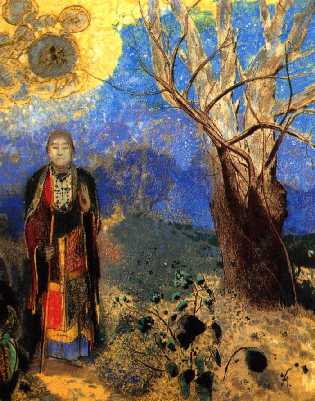
Odilon Redon 1840–1916

Odilon Redon was a French symbolist painter, printmaker, draughtsman and pastellist. Redon had a keen interest in Hindu and Buddhist religion and culture. The figure of the Buddha increasingly showed in his work. Influences of Japonism blended into his art, such as the painting The Death of the Buddha around 1899, The Buddha in 1906, Jacob and the Angel in 1905, and Vase with Japanese warrior in 1905, amongst many others.