Showing posts with label Theatre. Show all posts

Thursday, 2 December 2021

Edvard Grieg: The Death of Åse (1875)


Peer before the King of the Trolls.
1936 illustration by Arthur Rackham (1867-1939).

Those who are immersed in deep thoughts stumble easily. So says Ibsen in Peer Gynt. Pity the wistful philosopher. Pity more the unwitting victim of rumination; those drawn into their deepest candlelit and solitary chamber by accident of fortune or artifice. It is for such souls that Grieg’s Åses død was made.

The Death of Åse is a strings lament which rakes at the soul like tortuous winds. It suppurates with melancholy and menace. To allow it in, is to “war with trolls in heart and soul” and go hand in hand with the funereal into oblivion.
“So unspeakably poor can a soul then return
to nothingness in the misty gray.
You lovely earth, do not be angry
that I trampled your grass to no avail.
You lovely sun, you have squandered
your shining sprinkles in an empty cabin.”
~ Peer Gynt: Henrik Ibsen ~

It was in this unwitting state I attended the Bridgewater Hall, Manchester on 2nd December 2021. Emerging bleary-eyed from the isolation of pandemic, and complying with bag checks, mask-wearing and social distancing, we cringed at every stray cough amplified in the auditorium. The evening was entitled Finlandia, a celebration of Scandinavia at the threshold of the winter solstice. The rainswept darkness of the evening was beautiful and totally enveloping.

Edvard Grieg: The Death of Åse (1875)

Finlandia, a selection of Scandinavian repertoire was meticulously performed by students of the Royal Northern College of Music, and included:

Sibelius - Finlandia
Grieg - Piano Concerto
Alfvén - Swedish Rhapsody No.1, ‘Midsummer Vigil’
Sibelius - Valse triste
Christine Hals - Calling the Aurora (Northern Lights Kulning)
Grieg - Peer Gynt Suite: selection

To quote the Bridgewater Hall:
Perfect for winter, this concert celebrates the mystery and beauty of the far North. Two of the most famous pieces by Norwegian Edvard Grieg feature: his musical tableaux for Peer Gynt and his stunning Piano Concerto, with its beautiful central Adagio, which will be performed by BBC New Generation Artist and Terence Judd-Hallé Award recipient, pianist Elisabeth Brauß. Film composer and vocalist Christine Hals, known for her Scandinavian herding call in Disney’s Frozen, brings the unique sound to her ‘Calling the Aurora’. Hugo Alfvén contributes his light-hearted Midsummer Vigil, a symphonic rhapsody that gets right to the heart of his homeland’s folk music, whilst Sibelius is represented by his haunting and melancholy Valse triste and his stirring tribute to his homeland, Finlandia.

Haunting indeed.

Thursday, 30 November 2017

Henrik Ibsen: Hedda Gabler


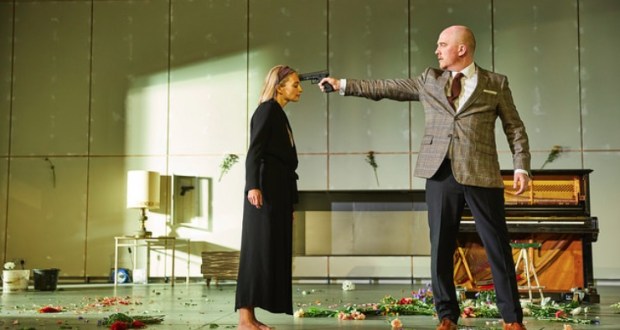
Last month I went to see The National Theatre’s production of Ibsen’s Hedda Gabler at The Lowry Theatre, Salford. Originally written by Henrik Ibsen the new version by writer Patrick Marber takes a innovative & modern approach to a classic text, with direction by Ivo van Hove.

First of all; when I bought my tickets for the play online, the Lowry booking system was showing nearly every seat full, and as a result I booked seats in the circle tier, stage right. Unfortunately about 75% of the action in the first act was performed at the right hand side of the stage, so I missed HUGE sections of the play. (i) This was completely unnecessary- using the right hand side of the stage wasn't for any other reason than to appear funky and quirky and didn't add anything to the narrative of the play; (ii) Why oh WHYYY did the Lowry even SELL tickets when the view was so obscured? (iii) In any event, about HALF of the theatre was EMPTY so I was unnecessarily pegged to a restricted view which was EXTREMELY FRUSTRATING. In the 2nd half, we were able to move seats on the advice of a benevolent usher, but by then the damage had been done. So that was a bollock dropped.


Secondly- the good bits. And there were many. The production (apart from the unnecessary concentration on stage right in the first half) was excellent- futuristic, sparse, yet honouring/ referencing certain timeless components of Ibsen's metre (the mildly tweedy costume, and deferential/ condescending tension in the dialogue notably). The phantasmagoria of set design and lighting were inspired. The intermittent use of Joni Mitchell's Blue added emotional depth and an enchanting dimension. In particular, I found Brack (Adam Best) compelling and the overall balance of the play produced a taut, intense experience.

BUT (and it is a BIG BUT). I found actress Lizzy Watts utterly unconvincing as Hedda. Every time she opened her mouth I could feel the scope and feel of the play diminished by her parochial style, her wretched unemotional voice and failure to present Hedda as the dark spectre Ibsen created her as. In my view, Hedda has to grab you by the balls- either in an uncontrollable wave of raw sexuality, or as a beguiling but dangerous emotional tsunami (and ideally both). I wish I could say Watts suffered at the hands of Patrick Marber's writing, or was occluded or made unemotional by van Hove's direction, but quite honestly I think she acted poorly, and failed to engage in any visceral way with the inner workings of Hedda. The dressing gown/ slip as a 'dream- like' device took away some of her power overall but in the right hands I felt even that handicap (of not being able to use costume to surgical effect) would enhance Hedda's sexuality. This was (literally) "capped" off by an incredibly glib final suicide scene, where I was left thinking instead of designing a grand dramatic end, Watts had accidentally set off her gun and shot herself in the foot. Enough said.

"Do you think that is worth the trouble? 
Oh, if you could only understand how poor I am."
~Hedda Gabler~


Despite my acerbic review of Lizzy Watts here, I had an awesome night at the Lowry and delighted in watching a classic play in a timeless way. 

Tuesday, 11 July 2017

Shura: Demons, aka Pandemonium (1971)


Demons, aka Pandemonium (修羅 Shura) is a 1971 Japanese samurai jidaigeki / horror film directed by Toshio Matsumoto. Referring to asuras, the movie is based on Tsuruya Nanboku and Shuji Ishizawa's play Kamikakete Sango Taisetsu, and reflects the director's experimental filming background and theatrical influence. It was released on 13 February 1971 in Japan by the Art Theatre Guild and Matsumoto Productions Company, almost two years after the director's first feature-length attempt, Funeral Parade of Roses.
The film is a portrait of feudal Japan's society and culture. Related to older samurai genre films and the classic tale of the forty-seven ronin*, it begins with a colorful setting sun, but the rest of the film is shot in black and white.

* The revenge of the forty-seven rōnin (四十七士 Yon-jū-shichi-shi, forty-seven samurai), also known as the Akō incident (赤穂事件 Akō jiken) or Akō vendetta, is an 18th-century historical event in Japan in which a band of rōnin (leaderless samurai) avenged the death of their master. The incident has since become legendary.

Friday, 30 June 2017

Throne of Blood (1957)


Throne of Blood (Spider Web Castle) is a 1957 Japanese film co-written and directed by Akira Kurosawa. The film transposes the plot of Shakespeare's play Macbeth from Medieval Scotland to feudal Japan, with stylistic elements drawn from Noh drama, a classical form of music drama dating back to the fourteenth century.

According to Kurosawa:

"It was a very hard film to make. We decided that the main castle set had to be built on the slope of Mount Fuji, not because I wanted to show this mountain but because it has precisely the stunted landscape that I wanted. And it is usually foggy. I had decided that I wanted lots of fog for this film... Making the set was very difficult because we didn't have enough people and the location was so far from Tokyo. Fortunately, there was a U.S. Marine Corps base nearby and they helped a great deal; also a whole MP battalion helped us out. We all worked very hard indeed, clearing the ground, building the set. Our labor on this steep fog-bound slope, I remember, absolutely exhausted us; we almost got sick."

The film has received praise from literary critics, despite the many liberties it takes with the original play. In 1961, the Time review praised Kurosawa and the film as "a visual descent into the hell of greed and superstition." The American literary critic Harold Bloom judged it "the most successful film version of Macbeth." In his 2015 Movie Guide, Leonard Maltin gave the film four stars, calling it a "Graphic, powerful adaptation."

Wednesday, 31 May 2017

Charulata: Satyajit Ray (1964)


The film contains a famous scene in which Charu (Madhabi Mukherjee) sings Rabindranath Tagore's song "Phule Phule Dhole Dhole" on a swing, while looking at Amal (Soumitra Chatterjee). The scene is referenced in the Bollywood film Parineeta during the song sequence, Soona Man Ka Aangan. Indeed, Parineeta 's Lalita (Vidya Balan) is dressed to resemble Nastanirh/Charulata 's Charu. Furthermore, Parineeta is based upon the novel Parineeta by Sarat Chandra Chattopadhyay who was a noted contemporary of Tagore (and who also wrote novels concerned with social reform).

Tagore's 'Phule Phule Dhole Dhole' is taken from the 'geetinatyo' (song-based play) 'Kaalmrigoya'. This is set in the second scene of the play, where the place of action is a forest. In the forest, a number of 'forest-goddesses' have gathered and this song is part of a chorus by the former. It was first acted out on December 23, 1882. 'Ye Banks and Braes' was composed by Burns in 1791, and is a very popular Scots song.

Santidev Ghosh gives a beautiful account of how Rabindranath was well-accustomed to European musical tradition even before his first visit to England when he was 17, in the 3rd chapter of Rabindrasangeet Vichitra. It is also here that the author clearly mentions that Tagore's first real brush with musical experimentation was with the play 'Valmiki Pratibha', first publicly performed in February 1881. This play had three songs set in European style, two of them being used in the voices of dacoits ('Kali Kali bolo re aaj' and 'Tobe aaye shobe aaye') and one Irish tune being used as a lonesome wail by the goddess of the forest ('Mori o kahaaro bachha'). The massive success of this prompted Tagore to remark that 'Valmiki Pratibha' was 'a garland of drama in a thread of songs'. Due to the immense success of 'Valmiki Pratibha', 'Kaalmrigoya''s songs had this structure too. Since Tagore was no stranger to European music, it is entirely possible that he had heard Burns' song and had composed 'Phule Phule Dhole Dhole' in a similar tune. In fact 2 other songs of Tagore, 'Kotobaaro Bhebechhinu' and 'Puraano Shei Diner Kotha' are heavily inspired from 'Drink to me only with thine eyes' and 'Auld Lang Syne' respectively.