Monday, 1 April 2019

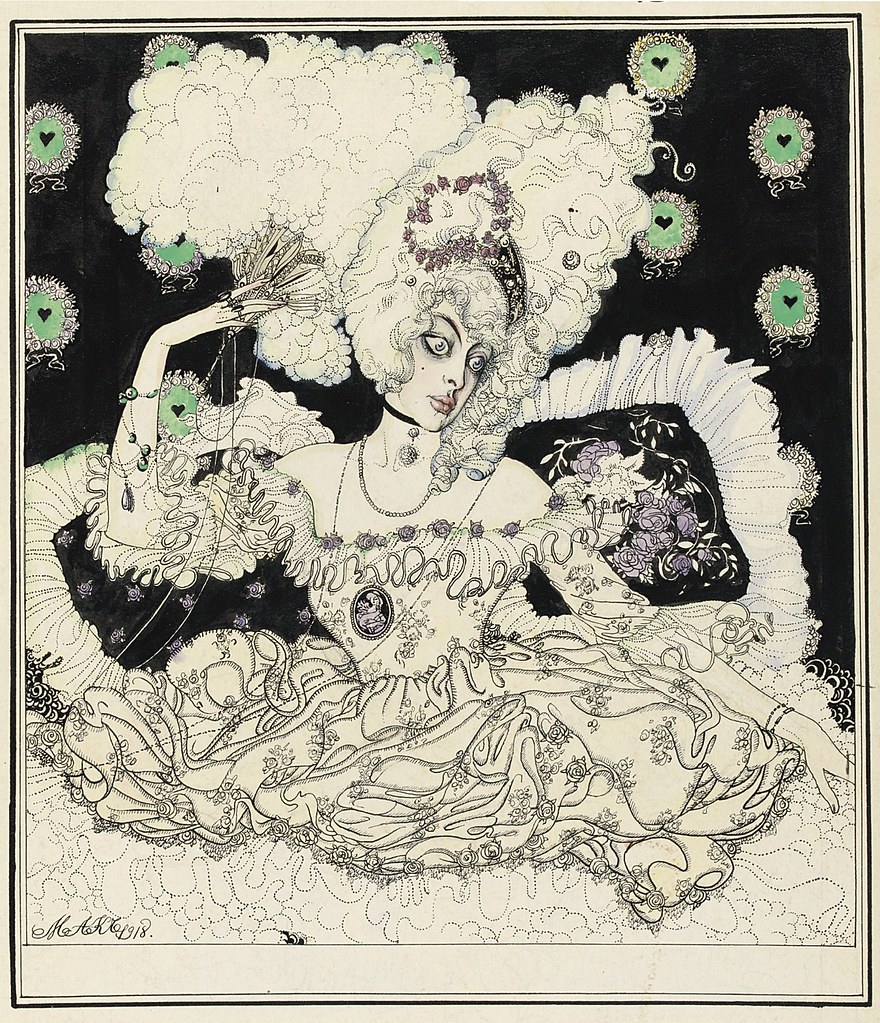
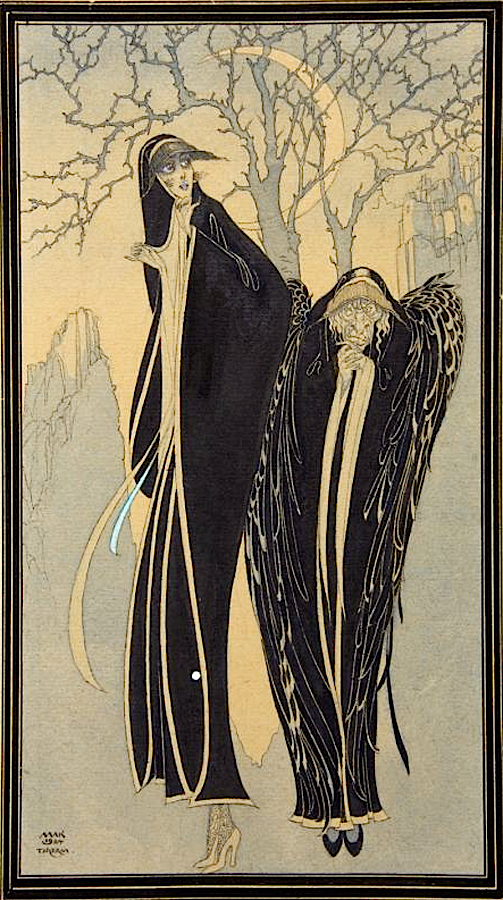
Pavel Ivanov aka Paul Mak (1891-1967)

Russian-born Pavel Petrovich Ivanov (who later changed his name to Paul Mak) is best known for his fantastical style and Middle-Eastern themes. Born to a noble Russian military family, Mak studied art at K. Iuon's studio in Moscow and illustrated for Moscow and St. Petersburg journals including Satirikon before enrolling at the Kiev Military Academy following the outbreak of World War I. He was wounded during action but by the end of the war had been promoted to the rank of Captain and served in the 89th Belomorskii Infantry Regiment. Imprisoned by the Bolsheviks in Butyrskii following the October revolution, Mak was swiftly rehabilitated and by 1920 was working as an artist for the Theatre of Revolutionary Satire in Moscow.

Mak's emigration in 1922 heralded the most exciting and creative period in his artistic career. Crossing Turkestan and Afghanistan, Mak settled in Persia, modern-day Iran, initially working as a racehorse trainer before an introduction to the Reza Shah led to his appointment as official court artist. During this period, Mak was devoted to the study of the Persian miniature, renowned for its exquisite detail and intricacy. He sought inspiration from the exoticism of Eastern tales and history and lent his stylized line to figures such as Salome, Tamberlane, and Chingis Khan. Perhaps the most fertile source for his miniatures was 'The Thousand and One Nights', a collection of tales that originated in India, Persia and Arabia.

Text from:
https://www.korshakcollection.com/paul-mak


Thursday, 21 March 2019

Liverpool Castle & Rivington Pike

Equinoxial perambulation. Starting from the Dovecote carpark, I walked along the large open paths of Lever park and down through beech woods towards Liverpool Castle and Anglezarke. From there I headed uphill through the woods and emerged on a promontory leading to Rivington Pike. Continuing along the ridge with breathtaking views of Anglezarke and out towards the Irish Sea, I took a dip into the terraced (Chinese) gardens, and ascended towards the Dovecot tower. From there, a mile or so brought me back to the car park. Fabulous walk just following my nose on familiar tracks. One thing that struck me was that despite the relative lateness of the year, the trees and bushes were shy and still only in bud, with catkins predominating over leaves. There were very few people about on this day, but those I did bump into were prepared for a long natter and to open their heart's treasures to a stranger. 


Monday, 11 March 2019

Turton & Entwistle and Wayoh Reservoirs

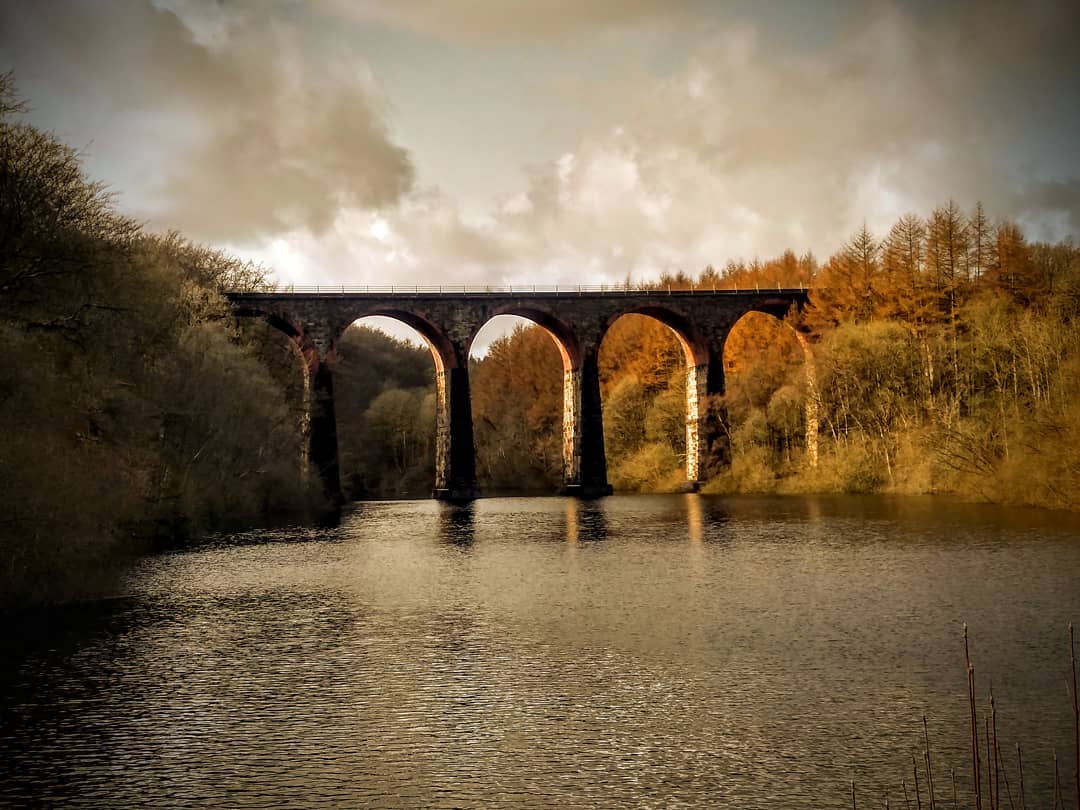
This is probably the best walk I know with proximity to a large town (in this case, Bolton). That said, circumnavigating both of these reservoirs is a distinctly rural experience, and particularly with Wayoh reservoir, it is possible to walk almost all the way around it without encountering a soul. Naturally, you can flex this walk and do one reservoir or the other. I have done it/them in various combinations; Turton & Entwistle only, Wayoh only, and on this occasion both. It really helps that the car park, and the fabulous real ale pub the Strawberry Duck, is centrally situated between the walks. There is even a train station with half-hourly trains. All this within a stone's throw from Bolton, and so few locals enjoying it. Like William Morris said, we sit starving amidst our gold. 


Wednesday, 27 February 2019

Wheelton Plantation

"Brinscall, about seven miles southwest of Blackburn, was a small farming community owned by the de Hoghton family, who were lords of the manor in the 16th century. When the cotton industry came to Lancashire in the 19th century, a thriving community of handloom weavers was built up in the valley area. William Christopher Wood built the present Brinscall Hall in 1876, and a calico printworks which employed a number of people but which closed in 1928. The ruins of many of these buildings are now surrounded by woodland known as Wheelton Plantation. In 1847 Liverpool Corporation bought the water rights of Withnell Moor from William Bashall Parke, a local landowner, and built Roddlesworth reservoir. The area is now owned by North West Water Authority and is part of the Anglezarke link of reservoirs and also a nature conservation area." From The Lancashire Village Book, by the Lancashire Federation of Women's Institutes (Countryside Books, 1990).

"Withnell Moor in Lancashire appears a lonely wilderness today, to be enjoyed by walkers and wildlife. But only 120 years ago, it was a thriving community and where today piles of moss-covered stones scatter the land, there once stood farms and cottages, green pastures and meadows, all thronging with families who lived, worked and played there." From Recollections of a Moorland Lad by Richard Robinson (Merlin Unwin Books, 2016). 

"In the space of little more than five square miles, there used to be nearly fifty farms, upon which hundreds of men, women and children depended. Then, almost overnight, the march of ‘progress’ robbed them of their homes and livelihoods, leaving behind a landscape frozen in time, with crumbling buildings and lonely vestiges of human habitation." From Lost Farms of Brinscall Moors, by David Clayton (Carnegie Publishing, 2011). 


Sunday, 20 January 2019

River Roddlesworth & Halliwell Fold Bridge

This was a quick January breezer just to get some fresh air and try to manufacture a feeble microgram of vitamin D or two. The woods were bleak yet beautiful at this time of year, with the canopy open to the heavens. I can't believe after walking in these woods as often as I have, that there is an on-off waterfall depending on what time of year you go (Halliwell Fold Scar) AND further up towards Tockholes, an abandoned/ half demolished ancient manor house in the old township of Tockholes that was largely rebuilt in the 1770's (Hollinshead Hall). Had I known about them at the time, both of these features would have been wonderful additions to our walk, but somehow you gotta roll with the punches and do what the gods have in store for you. 


Sunday, 9 December 2018

Franz Wacik (1833- 1938)

Franz Wacik was originally a student at the painting school Strehblow. Later on he studied at the Kunstgewerbeschule Wien with Alfred Roller . From 1902 to 1908 he studied painting with Christian Griepenkerl , Franz Rumpler and Heinrich Lefler at the Vienna Art Academy. Wacik devoted himself to book illustration, mainly in children's and youth books. He illustrated mostly in color, works by Hans Christian Andersen , fairy tales of the Brothers Grimm , stories by ETA Hoffmann , Hugo von Hofmannsthal , Clemens Brentano, and also the folk book by Till Eulenspiegel. For the series of books on Austria's Hall of Fame he took on the volumes on Franz Schubert and Franz Grillparzer, for the weekly magazine The Muskete he made hundreds of color illustrations, and also contributed to the Youth Red Cross. His works particularly stand out for the ambitious series Gerlach's Youth Library, again with Andersen's Fairy Tales and illustrations to Baron von Münchhausen.


Jose Gonzalez: With the Ink of a Ghost (2015)


With the Ink of a Ghost is the opening track of Swedish singer-songwriter Jose Gonzalez's 3rd studio album Vestiges & Claws. It was released on 17 February 2015 on Mute Records.


"These are incredibly moving songs full of bittersweet asides that strike you at first with their haiku-like simplicity, only to draw you deeper into González's iceberg of ideas. Ultimately, it's this ability to stop you in your tracks and hold you with the warmth of his voice as you contemplate your existence that makes Vestiges & Claws such an arresting, uplifting joy." (Matt Collar of AllMusic )

Got to agree!

Thursday, 13 September 2018

Lytham St. Annes

This was one of those impromptu days where you end up going wherever your nose leads you, and it works out to the good. It started out with me playing taxi driver and chaperone to my mum, who had a hospital appointment in Liverpool. We drove from Stockport to Liverpool, and after the appointment, we decided it was too nice a day to just head home, so I suggested Lytham St. Annes. 

Like a complete dope, I thought Lytham was only just north of Southport, and indeed it is, but necessarily via Preston and over the Ribble, via the M55 and far & away. Hey ho. We got there in the end and found the parking on the seafront easy. Mum was feeling well enough to walk along the promenade, into the town where we had fish and chips al fresco, and then through some of the funky arcade novelty/antiques shops, and back again to walk along to the windmill. We spent some time lingering on a bench looking out across the Ribble, in the gentle lucency of the sun, cosseted by a warm tidal breeze. In all, it was a perfect unplanned visit to the seaside capped off with an obligatory ice cream. 

Although it was a good week before the equinox, there was a sense of harmony and balance in nature that day. The tide swelled and swallowed up the estuary and rickety jetty. The sun arced boldly across the sky, seeking its rest and extinguishment in the Irish sea. The journey back was uncomplicated. We had waited for rush hour to peter out before we set off, and the sky was illuminated by a scarlet sunset awash with magic and awe.


Wednesday, 25 July 2018

Fairfield Half-Horseshoe Fail from Grasmere

Always a bold move to place yourself in somebody else's hands when it comes to planning a walk. All the more bold when your guide is one of those sans-map, winging it kind of sporty types who believes they can just excavate their way out of any trouble with a bowie knife (avalanches, broken legs, earthquakes, difficult to open tupperware boxes, etc). Never trust a walker who doesn't wear socks: never trust anyone on the tops!   

So I can't say for certain the route I traversed, but I know we started in Grasmere, passed Alcock Tarn, and headed up the first half of the Fairfield Horseshoe at breakneck speed. I just wasn't fit enough and pegged out a couple of times on the way up, not that Buzz Lightyear was bothered, having trotted off ahead by a few furlongs. Although I had (literally) done the hard yards and managed to ascend Fairfield (the rest being ridge walking), I was just in shreds so we took a turn east and descended back to Grasmere along a reasonably pleasant path not pictured below (if only I had been in any fit state to enjoy it). By making the impromptu descent I think we carved about 8km (5 miles) off the intended walk for which I was existentially thankful. This is only the 2nd walk I have had to cut short in my life, but it does show you even experienced walkers are not invulnerable and emphasises several time-honoured rules:

1. Always look out for your buddy, tracking back if you have to

2. Always have a PLANNED off-ramp (escape route) off the mountains and don't be ashamed to use it.

3. Even if you are fit enough to accomplish a walk, be prepared for the unlikely event of becoming unwell or incapacitated. Even a twist of the ankle can quite radically change the calculus of a walk.

4. Tell somebody who is not on the walk where you are going and an approximate time of return.

5. Keep your mobile charged. 

Stay safe!