First Aid Kit is a Swedish folk duo that consists of the sisters Klara (vocals/guitar) and Johanna Söderberg (vocals/keyboards/Autoharp/bass guitar). In 2008, they became internationally known by their YouTube video cover of the Fleet Foxes's song "Tiger Mountain Peasant Song" that gained significant Internet popularity. They have now released three albums, two EPs and a handful of singles. In 2015 they were nominated for a Brit Award as one of the five best international groups. "Wolf" is from their 2012 album The Lion's Roar, and "Stay Gold" is from their eponymous album of 2015,

Showing posts with label North Utsire. Show all posts
Showing posts with label North Utsire. Show all posts
Monday, 4 December 2017
First Aid Kit: "Wolf" and "Stay Gold"
First Aid Kit is a Swedish folk duo that consists of the sisters Klara (vocals/guitar) and Johanna Söderberg (vocals/keyboards/Autoharp/bass guitar). In 2008, they became internationally known by their YouTube video cover of the Fleet Foxes's song "Tiger Mountain Peasant Song" that gained significant Internet popularity. They have now released three albums, two EPs and a handful of singles. In 2015 they were nominated for a Brit Award as one of the five best international groups. "Wolf" is from their 2012 album The Lion's Roar, and "Stay Gold" is from their eponymous album of 2015,

Thursday, 30 November 2017
Mazzy Star: Fade Into You (1993)
OK so blogging this I got carried away and had to include Into Dust from the same album.
If psychedelic music had a voice in '90s post-punk, Mazzy Star may have been its strongest reincarnation. That doesn't necessarily mean that fans of the Jefferson Airplane and the Grateful Dead will find the band to their liking, however. Mazzy Star much preferred the dark side of psychedelia, as exemplified by the most distended tracks of the Doors and the Velvet Underground. Their fuzzy guitar workouts and plaintive folky compositions are often suffused in a dissociative ennui that is very much of the '90s, however much their textures may recall the drug-induced states of vintage psychedelia.
Although Mazzy Star was nominally a full band, they were basically the core duo of guitarist David Roback and singer Hope Sandoval with backing musicians. Roback boasts a long history in the paisley underground, with the Rain Parade and Opal. He came across Sandoval after hearing a tape she had made as part of a folky duo, Going Home. (The Going Home album that Roback subsequently produced remains unissued.) Sandoval ended up replacing Kendra Smith on Opal's final tours. After Opal dissolved, Roback and Sandoval continued to work together as Mazzy Star, and released their first album for Rough Trade, She Hangs Brightly, in 1990.
Rough Trade's U.S. branch went under shortly afterwards, but luckily Mazzy Star were picked up by Capitol, who kept the debut in print and issued their follow-up, 1993's So Tonight That I Might See from which the tracks above are taken. There isn't much to differentiate the two albums, though that's not necessarily a criticism. Both share similar strengths and weaknesses: appealingly dreamy and atmospheric arrangements, rambling distorted guitar workouts, and lyrics that mix the haunting and the meaninglessly vague. Tonight That I Might See had been around for about a year before it suddenly got hot, reaching the Top 40, and spinning off a small hit single, "Fade Into You." Even in the wake of this surprise success, Roback and Sandoval remained as enigmatic and aloof as their music, rarely submitting to interviews, and offering mysterious, unhelpful replies when journalists did manage to talk with them.

Text from All Music Mazzy Star Biography
Dugald Stewart Walker (1883-1937)
Dugald S (Stewart) Walker (1883-1937) was an American artist associated with the Golden Age of Illustration. He was a painter noted for his lyrical depiction of scenes and human form influenced by Art Nouveau and Impressionism.
His first comprehensive suite of illustrations appeared in Stories for Pictures (1912). Further commissions followed, in the form of his illustrations for Fairy Tales from Hans Christian Andersen (1914),Dream Boats and Other Stories (1918), The Wishing Fairy's Animal Friends (1921), Rainbow Gold (1922), Snythergen (1923), The Six Who Were Left in a Shoe (1923), Many Wings (1923), The Dust of Seven Days (1924), Squiffer (1924), The Golden Porch (1925), Orpheus with his Lute (1926), Mopsa the Fairy (1927) and Go! Champions of Light (1933).
Walker displayed an outstanding eye for colour and was also superbly gifted throughout his detailed monotone illustrations. His own Foreword to Fairy Tales from Hans Christian Andersen (1914) provides some insight in the beautiful soul that created such wonderful images - part of that Foreword follows:
"I have never been anywhere except Richmond, Virginia, and New York, because I have always been told that only grown-up people were allowed to travel. But the good East Wind and the kindly Moon have taken me on rapturous journeys high above the world to get an enchanted view of things. In this book I have put some of my discoveries, but if you are looking here for real likeness of the things that any one could see if he were grown up, you had better close the covers now. You cannot expect me to draw an exact picture of the North Pole or of a Chinese lady's feet or of a sea-cucumber. But if you are interested in what the East Wind or the Father Stork or the Moon told me, then look with my eyes and you will not mind very much if the courtiers in the ogre's court, or the dock leaves in the Garden of Paradise, are not just as a grown-up person thinks they should be. After all is said and done, what the young ones say about it is the all-important matter."
Text from Spirit of the Ages Bio


His first comprehensive suite of illustrations appeared in Stories for Pictures (1912). Further commissions followed, in the form of his illustrations for Fairy Tales from Hans Christian Andersen (1914),Dream Boats and Other Stories (1918), The Wishing Fairy's Animal Friends (1921), Rainbow Gold (1922), Snythergen (1923), The Six Who Were Left in a Shoe (1923), Many Wings (1923), The Dust of Seven Days (1924), Squiffer (1924), The Golden Porch (1925), Orpheus with his Lute (1926), Mopsa the Fairy (1927) and Go! Champions of Light (1933).
Walker displayed an outstanding eye for colour and was also superbly gifted throughout his detailed monotone illustrations. His own Foreword to Fairy Tales from Hans Christian Andersen (1914) provides some insight in the beautiful soul that created such wonderful images - part of that Foreword follows:
"I have never been anywhere except Richmond, Virginia, and New York, because I have always been told that only grown-up people were allowed to travel. But the good East Wind and the kindly Moon have taken me on rapturous journeys high above the world to get an enchanted view of things. In this book I have put some of my discoveries, but if you are looking here for real likeness of the things that any one could see if he were grown up, you had better close the covers now. You cannot expect me to draw an exact picture of the North Pole or of a Chinese lady's feet or of a sea-cucumber. But if you are interested in what the East Wind or the Father Stork or the Moon told me, then look with my eyes and you will not mind very much if the courtiers in the ogre's court, or the dock leaves in the Garden of Paradise, are not just as a grown-up person thinks they should be. After all is said and done, what the young ones say about it is the all-important matter."
Text from Spirit of the Ages Bio


Maybe Middle Earth: The Tolkien Trail
“I feel that as
long as the Shire lies behind, safe and comfortable, I shall find
wandering more bearable: I shall know that somewhere there is a firm
foothold, even if my feet cannot stand there again.”
J.R.R.
Tolkien
I had a
very pleasant walking holiday in November which involved a couple of
nights glamping in the West Pennine Moors. The circular walk started
and finished at a village called Hurst Green, and took in Stoneyhurst
College (an independent school with large grounds full of historic
interest). Much of the return walk was by the banks of the river
Ribble, with extensive views over rolling countryside, woods and
farmland.

Interesting morning clouds

Middle
Earth? View from the glamp site, over Longridge Fell

Glamping
facility located near Hurst Green

Tolkien
Trail Walking Route. Starting in Hurst Green, to the left
(Image
from Ordnanve Survey Locate: Tail PlannerApp)
Walk Details
|
|
Estimated Time
|
2h 30 min
based on an average walking speed of 3mph
|
Total Distance
|
7 miles
|
Start/ Finish
|
Hurst Green Village (parking plentiful)
Lattitude: 53.8371
Longitude: -2.4793
|
Difficulty
|
Generally good paths throughout. Some mud
underfoot after rain. Mostly flat with some steep slopes.
|
Total Ascent
|
170m (558ft)
|
OS Grid Reference
|
SD 6855 3797
Explorer 287 (West Pennnine Moors)
|
The whole route of the
walk is closely associated with South African-born John Ronald Reuel
Tolkien (1892-1973) who was author of Lord of the Rings. Tolkien is
known to have stayed in the area, visiting his eldest son, John, who
was studying for the priesthood at the Jesuit seminary at St Mary’s
Hall, now the prep school for Stonyhurst College. This had remained
hidden until the discovery of a college visitors' book in which
Tolkien's name appears many times between 1942-47. Another one of
Tolkien's sons, Michael, also taught classics at Stonyhurst in the
1960s and '70s

Stoneyhurst
College

St.
Peter's Church Stoneyhurst 1

St. Peter's Church Stoneyhurst
There is little doubt
the Ribble Valley was an inspiration to Tolkien in writing The Lord
of the Rings. He is known to have been a keen lover of walking and
woodland, and such suggestion abounds in the countryside around
Stoneyhurst. Was Hurst Green (with its aptly named Shire Lane)
inspiration for Hobbiton? Was the Shireburn Arms, where the walk
begins, responsible for the River Shirebourne (or the Shireburn
family who built Stonyhurst)?

River
Shirebourne? A sunlit meander of the River Ribble at Moyser Wood
Stonyhurst College was
founded in 1593 at St Omer in northern France to provide a Catholic
education for English families fleeing Tudor religious repression.
Following the French Revolution in 1794, the Jesuits moved to England
and settled on the Stonyhurst estate.
The college has yet
more literary connections: poet Gerard Manley Hopkins was a member of
staff at Stonyhurst, and Arthur Conan Doyle, creator of Sherlock
Holmes, attended the college as a boy. The setting for The Hound of
the Baskervilles is thought to be Stonyhurst itself. Perhaps these
writers found life in the shadow of Pendle Hill an impetus for their
darker themes, with its lugubrious stare and foreboding tales of
Lancashire Witches.

River
Ribble slithering along during sunset

Interesting evening clouds
References
Marsh, Terry. Walking
in the Forest of Bowland and Pendle. Cicerone Walking Guides, 2008
BBC Lancashire
Lifestyle- Tolkien woz 'ere!
Stoneyhurst College: In
The Footsteps of J.R.R Tolkien (PDF, Ribble Valley Lancashire)
Lancashire Telegraph: A
twist in Tolkien's tale (Dec 2001)
Mail Online: Why the
Ribble is so Hobbit forming by Richard Abbott, Mail on Sunday (Nov
2001)
Countryfile Magazine
Online: Find the inspiration for The Lord of the Rings and the The
Hobbit in the British countryside. Mathew Lyons (Sept 2017)
Blade Runner 2049
Oh the noir!!!!!
Being a critical and churlish git by nature, and stung too many times by 2nd hand remakes, I was expecting a commercial bastardisation of my beloved original Blade Runner. But how wrong I was to doubt! 2049 remains true to the original and exceeds it in every respect; acting, plot, art & cinematography, and music. Screw the people moaning about the 163 minute duration of the film. As a cinematic experience it didn't last long enough!
Composer Jóhann Jóhannsson, who had worked with director Villeneuve before, was initially announced as composer for the film. But in July 2017 Jóhannsson got binned because Villeneuve "needed something different, and needed to go back to something closer to Vangelis's soundtrack". New composers Hans Zimmer and Benjamin Wallfisch then took over. I'm so glad they did, because in addition to the Tarkovsky- esque visuals, the music really swung it for me. Bravo! I am looking forward to geeking out to it over and over and OVER again, alongside the Directors cut of the original, the "making of" etc etc etc. Bring it on.


Henrik Ibsen: Hedda Gabler

First of all; when I bought my tickets for the play online, the Lowry booking system was showing nearly every seat full, and as a result I booked seats in the circle tier, stage right. Unfortunately about 75% of the action in the first act was performed at the right hand side of the stage, so I missed HUGE sections of the play. (i) This was completely unnecessary- using the right hand side of the stage wasn't for any other reason than to appear funky and quirky and didn't add anything to the narrative of the play; (ii) Why oh WHYYY did the Lowry even SELL tickets when the view was so obscured? (iii) In any event, about HALF of the theatre was EMPTY so I was unnecessarily pegged to a restricted view which was EXTREMELY FRUSTRATING. In the 2nd half, we were able to move seats on the advice of a benevolent usher, but by then the damage had been done. So that was a bollock dropped.

Secondly- the good bits. And there were many. The production (apart from the unnecessary concentration on stage right in the first half) was excellent- futuristic, sparse, yet honouring/ referencing certain timeless components of Ibsen's metre (the mildly tweedy costume, and deferential/ condescending tension in the dialogue notably). The phantasmagoria of set design and lighting were inspired. The intermittent use of Joni Mitchell's Blue added emotional depth and an enchanting dimension. In particular, I found Brack (Adam Best) compelling and the overall balance of the play produced a taut, intense experience.
BUT (and it is a BIG BUT). I found actress Lizzy Watts utterly unconvincing as Hedda. Every time she opened her mouth I could feel the scope and feel of the play diminished by her parochial style, her wretched unemotional voice and failure to present Hedda as the dark spectre Ibsen created her as. In my view, Hedda has to grab you by the balls- either in an uncontrollable wave of raw sexuality, or as a beguiling but dangerous emotional tsunami (and ideally both). I wish I could say Watts suffered at the hands of Patrick Marber's writing, or was occluded or made unemotional by van Hove's direction, but quite honestly I think she acted poorly, and failed to engage in any visceral way with the inner workings of Hedda. The dressing gown/ slip as a 'dream- like' device took away some of her power overall but in the right hands I felt even that handicap (of not being able to use costume to surgical effect) would enhance Hedda's sexuality. This was (literally) "capped" off by an incredibly glib final suicide scene, where I was left thinking instead of designing a grand dramatic end, Watts had accidentally set off her gun and shot herself in the foot. Enough said.
"Do you think that is worth the trouble?
Oh, if you could only understand how poor I am."
~Hedda Gabler~
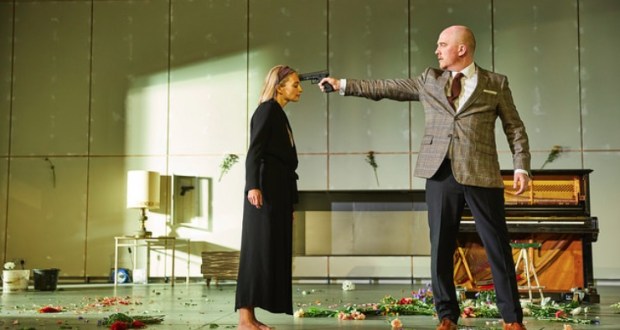
Despite my acerbic review of Lizzy Watts here, I had an awesome night at the Lowry and delighted in watching a classic play in a timeless way.
Tuesday, 31 October 2017


Saturday, 14 October 2017


Thursday, 5 October 2017


Subscribe to:
Posts (Atom)