Monday, 6 June 2016

Muhammad Ali

Any lingering vestige of the 20th century has ended with the passing of Muhammad Ali.  Thus it can be said he defined an era; the space race, civil rights struggles, mass media, Vietnam, and the Cold War. Ali is bound up with that time like  a name running through a stick of rock. With all the TV over his death, it gave me a bit of time to reflect on a couple of things.


Firstly, you would think getting thumped round the head repeatedly would be bad for brain health. Its just a kind of intuition most people have; that the prolonged boxing career Ali emarked on would make you punchy and trigger Parkinson’s (7 years as a journeyman boxer even after the onslaught of the Rumble In The Jungle). But there is no scientific evidence for that. I put this down to the small sample sizes and may be the methodology/ experimental design; you know how narrow the scientific community can be sometimes. But you would expect dementia to be a much more likely outcome from a long boxing career; with Parkinson’s it is the basal cells of the cerebellum (hindbrain) which degenerate.


Observing early footage of Ali, he is the exact opposite of a Parkinson’s patient; look at the table below.

Ali with Parkies
Ali in early years

Slow speech
Slow Movement
Shuffling Gait
Mechanical movement
Motor mouth,
Florid spontaneous poetry
Mohammed Ali Shuffle
Graceful movements, Hyperkinesis


I got round to thinking, maybe Ali had a congenital problem with dopamine secretion; in the early years expressing too much to the extent of being fidgety, and later on in a stage of disintegration. Of course, this could be a problem of unbalanced neurotransmitter secretion, or of receptor cells.


The stress curve of Hans Selye (1936; General Adaptation Syndrome) could be used to show a long period of hyper- arousal/ resistance phase/ eustress where the basal cells are responding to a pathology as yet undetected. He was certainly a force of nature at that time, prone also to fits of depression, nonsensical rambling and occasional outbursts of anger. This reminds me of an ADHD picture.


The other thing I thought (which I lament on his behalf) is that after that epic fight, Ali didn’t resign as he intended, but as mentioned went on to undertake a gruelling 7 year parade of head blows and knock outs. Had he resigned, perhaps he would have arrested his Parkinson’s sufficiently to maybe run as a Senator like Jesse Jackson, run a charity, or a community boxing project. I realise this blows somewhat in the face of my original idea (that his Parkinsons was a kind of teleological or genetic outgrowth) but maybe his pathological need for fighting was also part of the condition. Of course, both the endogenous (genetic) and the environmental (boxing) explanations could be simultaneously true. Whichever was true, we will never know, and sometimes its worth reminding ourselves that obscure neurological or endocrine illnesses can be wonderfully associated with genius as part of a whole package. Whether it is advantageous or disadvantageous is ultimately a value call which is subject to fashion. Ali shall remain as an icon of persevering against all odds.


North Utsire

Tuesday, 17 May 2016

One Man Photoshop Protests (2011)

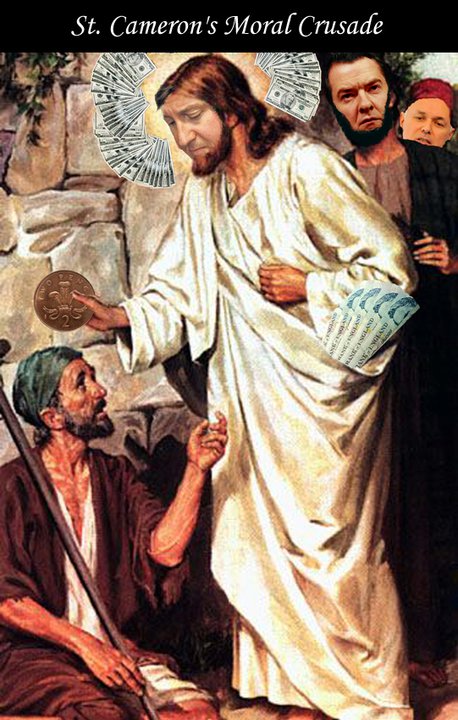
After the obscene birthing of the bastard child 2010 Lib- Con Tory government, and during the apoplectic convulsions of the 2011 London riots, I embarked on my own One Man Photoshop protest. In that bockety ferment, stories of the Bullingdon Club and Cameron’s moral piety piled up uncomfortably against unending health & environmental injustices resulting from unabated globalisaed corporatism. The Greece crisis, Occupy Movement and Anti austerity student protests were fuel to the fire. For a few months at least, it seemed to me, to quote Jim Morrison the “whole shit house could go up in flames.” Well it didn’t, and things returned to their shapeless trammelled drudgery, kicking the can further down the road. The media did a good job for their masters in portraying a narrative of moral savagery being the cause of the riots; the shooting of Mark Duggan was just an inconvenient fact. Some of these photoshops are better than others, but they’re all borne out of the same anger and outrage. One day the Lion will wake up and roar. Until then, you’ve got some crap photoshops to entertain you.
North Utsire 

London Riots


 Fireman Sam- Hero of the Cartoon Revolution


As a 16-year-old exchange student in Munich, Nick Clegg and a friend drunkenly set fire to what he called "the leading collection of cacti in Germany". When news of the incident was reported during his time as Liberal Democrat home affairs spokesman, Clegg said he had behaved "appallingly, irresponsibly, criminally" and that he was "not proud" of it. He was not formally charged, but performed a kind of community service. Its still a bit of a prickly issue for him when it comes to punishment of the London rioters.

North Utsire

Coalition Moral Piety

The Road To Parliamentary Democracy

 George Osborne: Obey

 St. Cameron's Moral Crusade

Deliver Us From Slow- Motion Moral Collapse

North Utsire

Food Industry Corruption

 What's The Worst That Can Happen?


 Haribo- Sponsoring Diabetic Ulcers Since 1920

McAcne

North Utsire

The Environment Industry

AstraZeneca- F@cking up animals and shit since 1999


McSlash & McBurn

McDonalds Green Logo

BP- raping the Earth since 1909

Godzilla in Fukushima

North Utsire

Starving Africa

These are probably the crappest of my One Man Photoshop Protests. What I don't like about them is they convey the (somewhat trite) idea that "Africa" is a weak, passive, exploited, ubiquitously poor continent without the wit or ability to resist globalisation, following on from my Poison Fire blog. Of course thats at best (or worst) part of a complex picture which I have no credentials to comment upon. That said, I think as Photoshop creations they are at least stark and certainly thought provoking, so I have included them below.

Half & half 


Let Them Eat Cake II 

Let Them Eat Cake III

Logo


North Utsire

Saturday, 9 April 2016

Cape Dolphin

When I look up to the blue sky;
the emptiness of what exists is clearly evident to me;
and I do not fear the doctrine of the reality of things.

When I look at the Sun and the Moon;
enlightenment  arises in a distant manner within my consciousness;
and I do not fear spiritual dullness and torpor.

When I look to the mountain peaks;
the immutable object of contemplation is clearly perceived by my consciousness;
and I do not fear the unceasing changes of more theories.

When I look down to the river below;
the idea of continuity clearly arises in my consciousness;
thus I do not fear unforeseeable events.

From The Song of Joy.
Milarepa (11th cent Tibetan ascetic)
Taken from the chapter: “A Mystic In The Tibetan Mountains”
Meditations on the Peaks, Julius Evola.


In the Falklands, on that bleak rock, moribund South on the way to the Pole, landscape takes on a new import. It moulds your outlook; flat and panel- beaten, looking out over hundreds of square miles of bog and rock, the eye and mind are drawn into an endless tapestry of untamed wild. And yet, sliding into the frozen seas of the South Pole, life rallies in one final defiant mardis gras of celebration; an elaborate veil of exultation before its fragility gives way to the mechanical grind of ice sheets, roaring auroras, the excoriation of sand and the plaintive cries of sea birds, lost and ranging like the radar of a solitary albatross. Bleak & empty to our human eyes, how rich the Falklands must seem to a weary seal or seagull, washed up from the endless desert of Antarctica.


And opened out, being exposed to the sky like a tablecloth of dainties, the Falkland landscape is raw, humble, enduring. With no extravagance of trees for cover, nothing is exempt from the violent vicissitudes of climate. And it is violent. Volatile. At times remitting, and in those periods of forgiveness I could say all is forgotten. But there are reminders everywhere of the immediacy of the winds, rain and hail. The low- growing shrubs with their tough exteriors; the tough hides of seals and penguins; the rocks polished, each like crystal gems uttering showers of wizened novellas. Even a calm day conceals such austerity.


There is no protection from the caprice of the open ocean. She may fall silent for a day. Then, return in foam and lace, mauling like a bereaved phantom, squalling and throwing up monsters from her restless belly. Her hair is fronds of strangled kelp, waving wildly as it writhes on rocks; sometimes she will tear it out and lash it on the exhausted and drenched chest of the panting shore. Here and there, she has teased the headlands with a sharpened salt finger & gouged out over time wondrous caves, gullies, channels and blow holes where the sea rears up and spews out of the ground. The timescales are torturously long, like a lover toying with her prey. In this way, the land has succumbed to this gentle coaxing and opened up, cracked and corroded, falling deeply into the sea in a hopeless act of surrender and joy. Here and there, broken boulders lie on the shore and become habitat for the wildlife; children of Father Land and their Mother, Mor. Rock cormorants nest in garrulous and impossible cliff fractures, their ceaseless tides of movement matching the erosions of ages past.


Viewed from a distance, this erosive force looms as a far more pervasive power. Looking across Falkland Sound, a 10 mile stretch of water separates Cape Dolphin from an area of uplift forming the unapproachable mountains of West Falkland. In the Sound, whales play. Their spumes of water glisten in the setting sun, and contrast as ephemeral plumes of white mist against the dour mountainous shadows of the background. Following the land mass along to the North, a jagged group of mountains terminate further out to sea; the Jasons. They have evocative names like Steeple Jason, Elephant Jason and Grand Island. For they are temples; amphitheatres where one might meet the gods. The most North- Westerly point of Falkland, the Jasons were often the first encountered artifacts of Falkland as explorers risked the rip tides and death currents approaching form Patagonia.


And as an imprudent afterthought, scanning the horizon yet further north terminates in a stubborn nub of rock known as Eddison Island. Taken together, the distant view of the mountains presents a panorama of jagged and various forms like so many loose teeth brutally dislodged by the pugilistic vengeance of the sea. As the sun moved round and began to set sharply over West Falkland, the line of rocks, each unique in character, came alive and rose to prominence, shining briefly but eminently in full relief. They then sank into hollows of exhausted depression and merged morosely with the ocean’s horizon as an act of acquiescence. Until tomorrow.


And everywhere is the penguin, roaming the landscape like a dislodged ghost. Neither fish nor fowl, huddled on rocks against the poaching wind. Guarding the kernel of life- eggs, fulfilling a duty of endurance out of the arms of the sea. Until she can return. Megellanics hide in burrows and stumble sometimes miles out of their way along ancestral paths to their colonies, even when time and erosion have forged quicker, more direct paths.


The Quartzite sands lent  purity to every beach on Falkland. Crystalline and swept clean, their open arms welcomed even human visitors, rare though they were. On the strandline, kelp formed a neat line of visual contrast to the sand. It was only the opaline vibrancy of the sea that prevented the eye being deceived into black & white monochrome. But even the blackness of kelp could not resist the restless, bleaching rays of ultraviolet, so intense at the South Pole. This, due to the thinness of ozone. And coupled with the onshore winds, basket kelp would wilfully yield and turn at first grey, then bone white, and take on a lightness of spirit it seemed, where it would frolic and dance, rolling along the shore line in laughs. Finally undergoing an act of transcendence, it became transformed as though sanctified. It had become a new creature.


Scrutinising the convolutions and contortions of the fronds of basket kelp was a fascination for me. In fact, the microscopic world took on immense properties with such a featureless horizon. I studied the intricacies of sponges, fine flowers and adaptations of plants, the meticulous structure of shells, bones, barnacles, rocks and lichens. All of nature was exposed, revealing her private secrets to me. This small world seemed to be uniquely mine. Whilst others trod this wonder underfoot, she spoke secrets to me of how she mysteriously clings to life here, how she arrived in this place, how she has unfurled and filled every niche over eras. Nature herself whispered occult findings in my ear, like echoes of the sea in the turbinating conches of shells.


This was exemplified perfectly by the discovery of Landfeld. The minitiarised landscape was a diverse wilderness of small stones, hardy plants and lichens which to an untrained eye was just a barren moonscape.

“If you could walk here miniaturized, as though in forested fairy glen;
And maybe see the damage done, you’d never walk in boots again.”


Camping at night by the beach at Cape Dolphin was spectacular. Sat by the fire, giving off giddy embers to the graceful night in hallelujahs of driftwood flame, we enjoyed a simple meal, drank a precious bottle of red wine, and sang Auld Lang Syne. I went down to the sea which had reached high tide. In the black, her frothing jaws opened and closed like the teasing of a menacing shark. In the distance, the tormented growls and barks of restless sea lions from across the cove betrayed the presence of their newly born pups. The shore was littered with the ancient bones of penguins and whale strandings.


Back at the warmth of the fire, we looked up at strange austral stars and were rewarded with firework showers of meteor storms, until we could not think of any more wishes to wish for. Just past midnight, the ISIS satellite slowly groaned over the sky in starry salutations. It was preceded by four intense flashes of penetrating light which briefly scorched the sky. We just could not explain it, sinking into hysterical imaginings of alien spacecraft. This added yet another layer of unreality to the theatre. And as a final reassuring crown to the evening; the far east horizon began to glow with cresting crimson light as the Moon rose through thin luminescent clouds in triumph over the whole scene. We collapsed into a chaotic but glorious sleep, punctuated by the sound of wild sea lions defending their young. 


North Utsire

Sinister Reptilian

Leopard Seal (Hydruga leptonyx)
Visitor.

Essentially solitary and circumpolar in distribution, usually on outer edges of pack ice, but does range widely to most Subantarctic islands, including South Georgia and the Falklands. Adult females, considerably larger than males, reach a length of some 12ft (4m), males about 10ft (3.5m). Upperparts darkish grey and underparts light grey, with spotting on throat, shoulders and sides- amount of spotting varies. Overall appearance rather reptilian, with a disproportionately large head for its long, slim body line. At close quarters the wide gape and three- pointed cusp- type teeth are distinctive.

Now fairly uncommon, although at one time was a regular visitor to certain beaches. There is one unconfirmed record of breeding. More commonly seen in winter, but may haul out at any period of the year. Appear to prefer open sandy beaches, or perhaps they are more difficult to spot on rocky surfaces. Feeds on a wide range of food, taking fish, squid, krill, other species of seal and penguins. Perhaps due to its carnivorous habits and appearance, has rather a bad reputation for being fierce toward man; however, there are no recorded incidents of unprovoked attacks. Perhaps in time this reputation will change in much the same way as it has done with the Killer Whale.

Ian J Strange
Wildlife of The Falkland Islands & South Georgia
  

Leaving the ruggedness of the M25 circular, and driving to Cape Dolphin Farm to part with the modest fee to the owner, a whole new panoply opens up. Cape Dolphin is wild! The only way to travel it is off road in a 4x4; at best, there are sections of grass- track or muddied path but for the most part; bog and heath. We got stuck on one occasion, trying to cross a water filled gully. Reaching the summital point on the Cape, the sea emerges as a restless panorama, offering vibrant felicitations to the eye, but only brooding comfort to the heart. 

Making camp just above the strandline on a long isolated beach on Cape Dolphin, we took in our surroundings. The Cape is uninhabited and projects out like a long stubborn yet optimistic finger into the South Atlantic ocean. Following your eye line out beyond the kelp forests, there is nothing but wild restless ocean. 1000 miles north is the eastern coast of Argentina. Beyond that, looking north from a different angle; nothing but 4000 miles of ocean until you reach Greenland. Staring out on this vista was the only time in my life I had realized what it means to be alone.

It was New Years’ Eve and we were the only people on the Cape. There were no people for maybe 100 square miles and no signs of human existence, save for an old makeshift square- shaped pen half full with faded buoys, frayed fishing ropes and bleached pieces of plastic rejected with caprice by the wild ocean. That is when she hadn’t absorbed the junk wholesale into her dark churning stomach, never to be seen again.


The sheer feast of wildlife this eminence of rock throws up is a wonderment of the improbable as though the eyes are disembodied and floating slightly in a bacchanalian reverie. You are invited to just let the carnival proceed in a flow of its own time and making. Like looking down the eyepiece of a microscope, the sea floor has been magically uplifted to reveal a strange land of diverse and extravagant living forms. Driving along the Cape, alien landscapes of deep scarlet sorrel, punctured by vivid greens of Bog Balsam are oddly juxtaposed with the browns and fauns of dry heath. Occasionally, there are Quartzite dolomites, or violent blow outs where jealous crying winds have gouged out chunks of land.

Magellanic penguins shuffle freely about, sometimes stumbling or sliding drunkenly into a hollow. They resemble a care home where the inmates have taken over the drug cabinet and randomly walk about carelessly.   The periphery of the Cape gives way to precipitous cliffs, slopes and even giant dunes peppered by the zigzag of penguin paths. Rock cormorants cling to cliff faces in their letter box colonies. Where the land graciously extends  to the sea, large inland saline lagoons form with many thousands of squabbling waders geese and seagulls. These form extensive open coastal greens in places, which communicate with the sea when the tidal moods of the witch- Moon command it.

Incisors!

Eye opening: encouraging sign.

The extremities of bleak coastline are haunted by Neptune, who heaps angy trident blows of waves on endlessly stoic Silurian- Devonian rocks. Southern Petrels nurture their pterodactyl young here, giving the sensation that time has not changed this place since the dinosaurs were alive. Meanwhile with declamatory red chest plumage, darting amongst the cushion plants, curious Falkland thrushes dance with plovers under the worldly watchful and greedy eyes of the Caracara. All flowers are open in this misdsummer saturnalia and furnish the air with the inebriation of exotic perfumes. To this euphony of spice are mixed Christmas Bush, Coastal Nassauvia, and the camphor of Bog Balsam.

Setting camp, although as one, we suddenly looked up and along the mile- long sandy beach towards the trajectory of the setting sun. What propelled us to do so, can only be described as a force greater than ourselves. “Look, a leopard seal!” From a distance of maybe a quarter of a mile, we instinctively knew it was a leopard seal. I have never seen one before apart from on TV or books, but even from that distance it was distinctly so, lying high up on the shore and motionless. Taking cameras, and abandoning our unfolding camp, we just moved as quick as we could towards it, knowing this was a rare once in a lifetime event. It seemed pre ordained.

Approaching with caution, we could see the creature was not fully alert, and looked entirely exhausted. Knowing as I do now, that leopard seals are rare visitors to Falkland, and rarer still in summer, and that they most often come from South Georgia, a swim of 1550km, the state of exhaustion is not surprising. Given the size difference between males and females, I am going to say I think it was probably a female, as she was a good size. Even though she was motionless, we gave her plenty of respect and kept a reasonable distance. Her breathing movements were evident, but more so her heart was pounding at a rate of (I would guess) over 120 bpm. She had obviously come a long way, and hauled up to rest at great cost. We took some photos, made observations, and moved on.


I later found out that in the austral summer, male leopard seals are in the habit of hanging upside down in the water and making mating calls in order to summon a female. Was this a female who had been lured by a siren call? Or maybe a bold large male who had drifted too far from the subantarctic currents in search of a mate? Certainly there were no signs of wounds which might suggest an acrimonious fight over a female, or warding off unwanted attention. Maybe our seal was a female who had recently conceived and was looking far and wide for a suitable niche in which to birth later on in the year. We will never know what circumstances led to the arrival of the leopard seal on the beach, but as the omens looked bleak for her, we shared a moment and moved respectfully on.


Later in the evening, as the sun was setting, and we were making food before the spectacle of night swept the Cape, we again saw movement from the direction of the leopard seal. Making our way down to the shore, we could see the leopard seal was on the move and looking much better. Her movements were smooth, muscular and undulating as she edged her way down to the shore (a journey of a hundred and fifty yards or so). Every so often, she would pause and these punctured moments in time allowed us to photograph her in the light of the setting sun. Patagonian geese amassed at the waters edge, goading her on. The waves beckoned her back to the deep nourishing womb of the sea where she could be replenished by cool waters and plentiful food. The final 20 yards or so were a joy to watch; her glistening skin lapped by the tides, until she was buoyant and absorbed again into the sea. With powerful muscular movements our leopard seal slipped into the night, with only swirling foam to remind us of the drama we had just witnessed.  


North Utsire