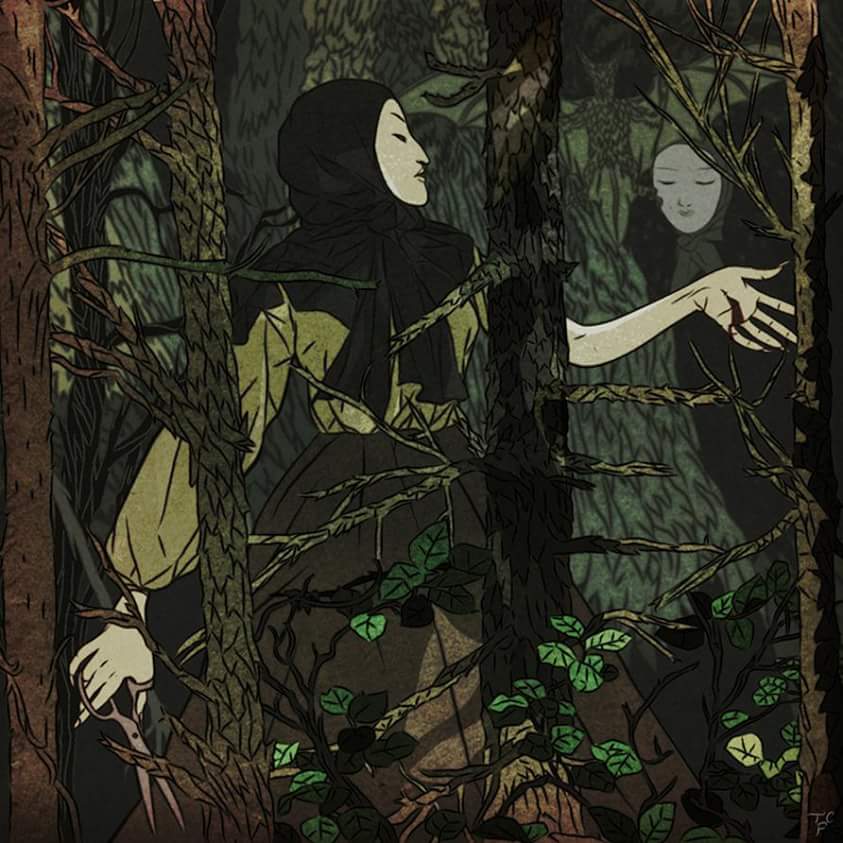
Here is a selection of Pam Grossman's supernatural Tin Can Forest illustrations. Her book What is a Witch looks well worth checking out. Perhaps I am anticipating autumn with its enchanted nights drawing in, unearthly staring moons, tortured wisps of log fire smoke pierced only by the spectral hooting of owls in the woods. Maybe even during the long summer haze there is a piece of us that never thaws and belongs to autumn. Knowing the dark dance of Halloween is waiting for us at the other end of summer's dying days makes the descent into the underworld all the more bearable. I know, "get some vitamin D, right?"
North Utsire
Saturday, 13 August 2016
One Straw Revolution: The Movie
North Utsire
Monk Without a Sense of Humour
Baked Haddock in Greens with Anchovy “Butter”
You should
never leave stuff in the hands of a creative person. I mean, don’t say to them
“just mind that Magnox reactor for us, see its safe”, or “don’t press that red
button whilst I’m away”. That’s how accidents happen. But also, occasionally,
good things. This is a recipe I came up
with after changing another internet recipe I’d found totally beyond
recognition. I cant even remember where I found the original. There certainly
wasn’t a haddock in sight. I know it had anchovy and unsalted butter in it, but
mine has got “butter” in it. In this case that means a 50:50 mixture of ghee
and coconut oil. Of course you can go back to plain old unsalted butter after
you’ve tried this, but quite honestly, what would you do with the other half of
the butter packet? I mean, sprinkling salt on toast just isn’t right. Its
positively delinquent. So give this unlikely mix of flavours a go and see what
you think.
The recipe
is quite flexible, I’ve found. You can take the asparagus and green beans
mixture and use it with anything, ranging from toast, to omelette, to dahl. In
this recipe it finds itself on top of haddock and roast peppers with mushroom.
1 lb
green beans
1 lb
asparagus tips
Any
greens will do, such as pak choi, cabbage, lettuce leaves, etc.
|
Steam the
greens for 20- 30 minutes and take off the heat. Prepare the other
ingredients whilst waiting.
|
4 haddock
fillets
half
punnet Mushrooms
2 sliced
peppers
|
Prep
these ingredients and set to one side ready to receive the greens as garnish.
|
2 Tbsp
coconut oil
2 Tbsp
ghee
|
Put on a
medium heat in a large pan, sufficient to melt the oils.
|
1/8 tsp
ginger powder
1/8 tsp
turmeric powder
¼ tsp
garam masala
1/8 tsp
fennel seeds
1/8 tsp
kolonji seeds
¼ tsp
mustard seeds
2 minced
gloves garlic
|
Add in
the spices, stirring quickly.
|
½ cup
fresh orange juice
1 Tbsp
lemon/ lime juice
½ tsp
anchovy paste
|
Before
the spices stick to the bottom of the pan, or burn, add the fluids and the
steamed vegetables.
|
6 tinned
oil packed fillets with oil discarded
|
Add in
the anchovies. Allow to cook thoroughly through for 5- 10 minutes, stirring
frequently. By that point the dish should have sufficient body but not be too
runny.
|
Cover the
haddock & vegetables. Oven bake for 20- 30 minutes until the fish is
cooked through & flakes succulently.
|
|
Mixed
Seeds
Olive oil
|
Use seeds
and oil as a dressing. Whole thing goes well with potatoes. Serves 4
|
North
Utsire
Grannie (1971)
Here’s another album all but lost in the depths of time
until rediscovered circa 1993, and re- released by Wooden Hill in 2010. It’s
been described as "guitar-dominated heavy progressive" but I
disagree. Its more like a connosieur blend of psychedelic prog- rock,
reminiscent of Uriah Heep and Iron Maiden, with a hint of Led Zep thrown in.
They seem to defy definition, but are undeniably British psych- rock:
“Very cool music that
screams London underground at the turn of the 60's into
the 70's. Too bad the production isn't cleaner. If you like T2, Clear Blue Sky,
Fuzzy Duck, Hard Stuff, Pink Fairies etc you'll dig it.”
In 68/69, guitarist Phil Newton saw an advert in Melody
Maker for an all-inclusive deal at David Richardson’s SRT (sound recording
technology) business that offered 8 hours of studio time, a master tape and 99
finished LPs for £100. In 1971 the band booked SRT (established as Sky Studios
in 1968) and within 8 hours had recorded the full album - mainly for
themselves, plus gigs/friends and family. Incredibly, no copies were sent to
major labels/impresarios, and only 99 copies were ever pressed. The band began
to play on the London club circuit
at venues like The Greyhound, The Marquee and even the Roundhouse. They had a
residency at the Speakeasy in London ,
but had their gear & music equipment stolen whilst traveling (including one
of the first Mellotrons). Which put an end to things. Bloody shame.
Some random 70's dude with a Mellotron to his left
The recording quality is not brilliant, but given its with
us at all is nothing short of miraculous. In its December 2004 edition 'Record
Collector' valued an original vinyl pressing of the album at £850.
Tracklist
Leaving
|
|
Romany Refrain
|
|
Tomorrow Today
|
|
Saga Of The Sad Jester
|
|
Dawn
|
|
Leaving
|
Lineup
Bass
|
Dave Holland
|
Drums
|
Johnny Clark
|
Flute
|
Jan Chandler
|
Keyboards
|
John Stevenson (tracks: B3)
|
Lead Guitar
|
Phil Newton
|
Producer
|
Dave Richardson (2)
|
Vocals
|
Dave Holland, Fred Lilley, Jan
Chandler, Phil Newton
|
Sunday, 10 July 2016
Taste (album, 1969)
Taste was a blues/rock power trio from Ireland
in the late 1960s. It was lead by singer/songwriter/guitarist Rory Gallagher
who later went on to a long solo career doing his own thing. Taste only managed
to record two studio albums in its short career, they being Taste (1969) and On
The Boards (1970). The band had two distinct incarnations. First 1966-68 where
the members joining Rory Gallagher were Eric Kitteringham on bass and Norman
Damery on drums. From 1968-71, Richard (aka: Charlie) McCracken (bass) and John
Wilson (drums) joined Rory and were with him for the recording of the studio
albums.These guys are easily up there with the likes of Led Zep, Rush and Cream
but never seem to get the biscuit. It’s a rock n roll tragedy. But a kinda good
one too.
In a 1977 interview with ZZ Magazine (issue 23), Gallagher
said of the early years “It was very much a case of sleeping in the van, and
long hard grinds around the various clubs, but it was pretty enjoyable even
so... and then we just broke up — Eric wanted to start his own band and Norman
wanted to get off the road for a while, and so we packed it in. In Hamburg
we'd play 45 minutes in each hour, and we'd go on stage about four or five times
a night — that's weekdays… on Saturdays we had to do seven sets. I was never
there for months on end, like the Beatles, but it was good hard labour all the
same. I wasn't complaining though, because in the showband it wasn't unusual to
do five hours on your feet without a break... you'd get off the stage and your
fingers would be mashed to pieces. I enjoyed every minute of Hamburg
though. .. . it was fun unlimited really, because you often shared the bill
with another band, and we used to have a lot of good times.”
A 1969 ZigZag cover featuring Frank Zappa
Gallagher moved into blues from a Chuck Berry style of
playing: “ I began to hear people like Buddy Guy, and some of the older
acoustic players... it was just a gradual move; for instance I found out about
Willie Dixon from Chuck Berry records, and then discovered he also wrote songs
that were recorded by Muddy Waters.. . . and so I got into his music. You know
how you get interested in something and try to find out more it was like that
really."
Touring with Blind Faith in 1969, taste passed up the option
of gigging Woodstock . “I remember
the agent coming on board the bus in New York and asking if the package, which
was Blind Faith, Delaney and Bonnie and Friends and Taste, would be interested
in going up to Woodstock.Clapton was at the top of the bus and he turned around
and asked for a show of hands and it got voted down and voted down by quite a
bit. The guys in Taste, Rory included, kept their hands down - they felt they
weren’t important enough to be given a shout. Eric wanted to do it and I
remember whispering to him that, with all due respect to democracy, it was his
shout basically but it went to a vote and Woodstock
went on without us.” Although Rory and Taste missed out on the chance to play
to 400,000 fans at Woodstock , just
a year later, the band performed before an estimated 600,000 at the Isle
of Wight . The band’s performance was captured on film and has been
released on DVD .
Taste (1969) Track listing:
"Blister on the Moon" - 3:26
"Leavin' Blues" (Huddie Ledbetter, Rory Gallagher)
- 4:15
"Sugar Mama" (trad. arr. Gallagher)- 7:14
"Hail" - 2:35
"Born on the Wrong Side of Time" - 4:00
"Dual Carriageway Pain" - 3:13
"Same Old Story" - 3:32
"Catfish" (trad. arr. Gallagher) - 8:04
"I'm Moving On" (Hank Snow) - 2:29
All tracks were composed by Rory Gallagher except where
stated, and produced by Tony Cotton. It was released on the Polydor label in Europe
and Atco in North America .
Genuine GCSE Exam Answer
Marking an ocean of banal exam papers last week, I came across this desperate plea for help. I have changed the name of the student, and the school to protect his identity, but you get the idea.
12(c) Describe the changes that happen when DNA replicates.
I don’t blame you. I don’t blame the exam board. I blame the school for
handling my personal circumstances so badly. I would blame myself but I cannot
control what I cannot control. I’ve flopped this exam, that’s clear, but at the
time of writing it is 2:41 in the afternoon;
I am sat in my school uniform surrounded by an army of people I dislike and my
hands are sweating. I can’t change this, nobody can, but we all know that this
is bullshit. It’s all bullshit. Fuck you C----- School . Fuck you CAMH S*. This is a love
letter from your dearest, C----- x
*Note: CAMHS = Child and Adult Mental Health Services
North Utsire
Daily Schedules of Darwin, Freud, etc.
I saw this a while back on a blog called Truth Theory. It
said (quote):
"The one thing that every person in the world has in common
is time. We all have a day which consists of 24 hours, in which we can do with
as we please. Even so, person A can fail to achieve anything significant
within an entire lifetime, while person B is able to crank out success story
after success story. What is the difference between person A and person B? It is
definitely not down to a lack of time, because if one person can schedule their
time for success, so can another. The truth is people succeed or don’t succeed,
because of what they do with their time and the habits they form.
This info graphic shows the daily routine of 16 high
achieving people throughout history, what is really interesting about this, is
the fact that all the routines are very different. Which goes to show that
there is no set way to do things, but only a way which is unique to you and can
be reached through trial and error."
What really gets on my tits about this bourgeois crap is the
universal assumption that everybody is gifted with the “same” amount of time
per day, therefore this imparts some kind of equality on everyone and therefore
its your own lack of moral fibre or intellectual fortitude that accounts for
your miserable failures in life. If you look at these graphics you will see
that nearly all of these “intellectual giants” have one thing in common: they
are all freed from the misery of drudgery and toil to make ends meet, and
therefore have the luxury of indulging their creative fantasies. Presumably
behind the “genius” of Freud was a pathetic number of servants (those lesser
intellects who couldn’t manage their time any better) who had committed the
stupidity of having children, or sick relatives, or of putting their empty
howling bellies before going for a restorative walk or reading an edifying
book. That is, if they could read at all. I wonder what epic novels we could have expected
from Dickens if he was forced to clean toilets on minimum wage for survival.
Not much. No, not very much.
North Utsire
Cucumber, Tomato & Beetroot Raita
This really is a great, cooling raita which goes alongside
curries, salads, grilled fish, meats, bean dishes and just about anything else
you can think of. It keeps well and I make up a big batch of it in two mixing
bowls and work my way through it over a few days alongside different dishes. I
find it cool and pleasantly moistening to the mucous membranes, so it can be
used in your kitchen pharmacy to rebalance your gut after periods of excess or
in hot weather for example. The asafoetida adds a really interesting dimension
to the raita, so don’t try to skip using it. Many brands of asafoetida contain
some kind of wheat flour so be careful if you are on a gluten free diet; the
best asafoetida in my opinion is mixed with fenugreek powder instead, which
compliments the earthy flavour very well.
|
2 medium boiled, peeled and chopped beetroot
1 medium chopped cucumber 4 chopped vine tomatoes 1 cup thick yoghurt or coconut cream Salt to taste 2 tsp demerara sugar 2 tsp finely chopped green chillies 2 tbsp olive oil 1 tsp cumin seeds (jeera) Pinch of asafoetida (hing) Handful of roasted cashew nuts 1/4 cup freshly grated coconut
(alternatively 2Tbsp dried coconut)
Bunch of finely chopped coriander (dhania)
Mixed seeds
|
|
Monday, 6 June 2016
Kombucha
Kombucha is a home fermented probiotic drink. It tastes
quite like a nice fizzy lemonade. I am enjoying it from the fridge in these
summer days. You make Kombucha from a SCOBY (symbiotic colony of bacteria and
yeast) which is like a flat mushroom which grows on top of the fermentation.
The culture, also sometimes referred to as the
"mother," resembles a light brown, tough, gelatinous disk, which is a
living, growing organism. With each batch of the tea, the organism can
regenerate and create a new culture called the "baby," which can be
shared with a friend much like the sharing of a sour dough starter.
It may have been introduced to Japan
by a Korean physician by the name of Kombu around 415 AD. Today the tea - once
routinely used by Samurai - is widely used again in Japan .
Kombucha appeared in Germany
about the turn of the century from Russia .
This fermented tea drink became quite popular across Europe
until World War II with the shortage of tea and sugar.
For hundreds of years a tea has been made from Chaga (a
birch-tree mushroom) by the Russian peasants of the Alexandrove district near Moscow
to cure cancer. There is speculation that the Kombucha mushroom is related to
the Birch-tree mushroom.
Visitors to Russia
can observe the following typical sight on Moscow
street corners: a large metal drum, larger than a
beer keg, turned sideways and mounted on wheels. A spigot on one end releases a
brown bubbly liquid into a glass. Customers line up to pay for a draught, down
it in several gulps and return the glass to the vendor who wipes it clean for
the next customer.
The beverage enjoyed by Muscovites, other city dwellers and
villagers throughout Russia
is kvass, a lacto-fermented beverage made from stale rye bread. It tastes like
beer but is not alcoholic. Kvass is considered a tonic for digestion, an
excellent thirst quencher and, consumed after vodka, an antidote to a hangover.
It is also recognized that kvass is safer to drink than
water. Tolstoy describes how Russian soldiers took a ladle full of kvass before
venturing from their barracks onto the Moscow
streets during a cholera epidemic. Because kvass protects against infectious
disease, there is no worry about sharing the glass.
Russians have been enjoying kvass for at least one thousand
years. Wrote Pushkin: “Their kvass they needed like fresh air. . . ” Lomonosov,
a prominent scientist of peasant origins lived in “unspeakable poverty” as a
student. “With a daily allowance of three kopecks, all I could have by way of
food was half a kopeck’s worth of bread and half a kopeck’s worth of kvass. . .
I lived like this for five years, yet did not forsake study.”
Sometimes called "mushroom tea," kombucha has been
associated with a long list of health benefits. It's helpful bacteria
that support digestion and the immune system. It also contains enzymes, amino
acids, antioxidants and polyphenols. But relatively little scientific evidence
has confirmed the health claims of traditional cultures drinking the tea.
Recently, researchers from the University
of Latvia gathered 75 studies
attesting to the proven health properties of kombucha.[1]
For each litre of Kombucha you make, the recipe is:
1 litre water
1 green tea bag
1 black tea bag
4 Tablespoons Sugar (80-100g)
Be careful not to use hot tea near the SCOBY & allow I to
cool.
Sterilise thoroughly, unless you are using a batch process.
Initial fermentation: 7-14 days. Secondary fermentation can
be more than a month (I’ve never reached a limit where it becomes unpalatable).
[1] Ilmara Vina et al,
"Current Evidence on Physiological Activity and Expected Health Effects of
Kombucha Fermented Beverage." J Med Food 17 (2) 2014, 179–188
DOI: 10.1089/jmf.2013.0031
North Utsire
The Love Sick Monk
Subscribe to:
Posts (Atom)


.jpg)


